Skip to content
 Cameron Lovelace did 52 deals in his first full year in real estate, but he also had no life. “I made really good money, but I also had to give half of it away,” he says of his team years, when Zillow and realtor.com leads had him showing houses on weekends and late into the evenings. To fix his work -life balance, he had to do two things:
- Go solo and work listings
- Hire someone to take over the 80 to 120 calls a day he was making by himself.
Cameron hired what’s called an ISA. A real estate ISA (inside sales agent) prospects your lead data on a set schedule, has the first conversations, and hands you vetted appointments with notes and follow-up tasks already logged in your CRM. You keep the part only you can do: converting a seller who is ready to talk. Done right, the ISA multiplies your prospecting while you keep every judgment call.
Cameron works with Jasmine Lopez, who runs Scalable USA and supports more than 90 agents across the country with trained ISAs, an operations team, and data strategy. On the REDX Podcast, the two of them laid out how the model runs: what to delegate, how many hours an ISA should dial, what the nurture looks like for a seller who is 18 months out, and how long to wait before you decide it is working.

Co-authored by the REDX Publishing Team and:
Cameron Lovelace
Cameron Lovelace is a North Carolina listing agent with Real Brokerage who came to real estate from car sales and insurance, did 52 deals in his first full year, and rebuilt his business around listings and an ISA-supported pipeline.
Quick Links:
- What Does a Real Estate ISA Actually Do All Day?
- When Are You Ready to Hire a Real Estate ISA?
- Should You Train Your Own ISA or Hire a Trained One?
- How Many Hours a Day Should an ISA Prospect?
- What Should You Keep and What Should You Hand Over?
- How Long Before an ISA Produces a Listing?
- What Does the Follow-Up Look Like for a Seller 18 Months Out?
- Your First 90 Days With an ISA
Watch the full conversation on the REDX Podcast:
What Does a Real Estate ISA Actually Do All Day?
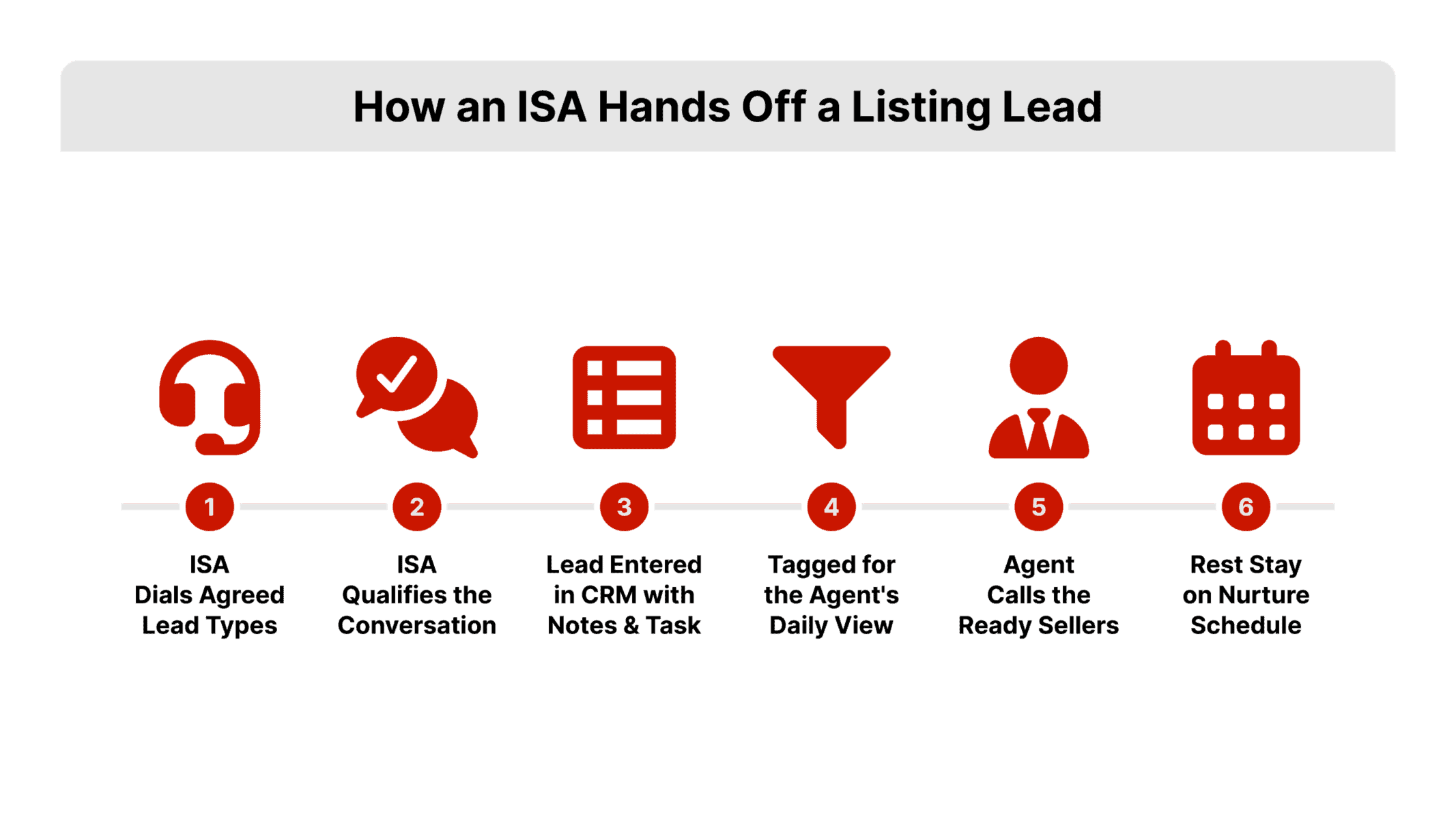
They dial your data, qualify the conversations, and leave you a queue. Here’s how Cameron manages it in Follow Up Boss:
- Helen, his ISA, works the lead types they agreed on and tells him each morning what she is calling and when.
- When a homeowner is worth pursuing, she enters the lead in the CRM with notes and a future task attached.
- Everything she touches carries her tag, so Cameron opens one saved view and sees the day’s work.
- He calls the ones that are close, and the rest stay on her nurture schedule.
“Nine times out of 10 the numbers are right, the emails are right,” Cameron says. The example he gives is a $425,000 sale in Stokesdale that Helen sourced. She had five or six conversations with the seller before Cameron ever spoke to him. He talked to the man once, showed up, and left with a listing. At the closing table the seller even asked why Helen had not come along.
Speed to that first conversation is the reason he wants the volume in the first place:
“We know that if we’re the first person they speak to, 80% of the time that’s who they do business with. And if we’re the first ones, and then I follow up like a wild man, then we should be good.”
Cameron Lovelace, on the REDX Podcast
If you do not have a CRM yet, Jasmine’s advice is to stop shopping and start with what you already pay for. “Just use your REDX,” she says. Vortex is included with every REDX lead subscription, and her team routinely finds appointments hiding in accounts agents already own. “We just popped the hood on a CRM the other day. 13 appointments came in.”
When Are You Ready to Hire a Real Estate ISA?
When you are the bottleneck and follow-up is what slips first. Cameron was making 80 to 120 dials a day, holding the relationships, and running the nurture himself. Despite all his calls, his follow up was suffering (and following up is where the money is really made).
Jasmine sees the same pattern in most agents who call her. “A lot of times we’ll open their database, and there’s tons of appointments that just pop out because they haven’t followed up,” she says. The agents who reach out are usually good at the business and short on hours, a different problem than needing more leads.
The two questions worth answering first
- Are you prospecting consistently right now? An ISA multiplies an existing habit. Jasmine’s clients who succeed already believe in the activity and want more of it.
- Can you convert what shows up? “What we found with some agents is the level of effort, their knowledge, their skill, the attention they put towards converting into a listing is just as important as the consistency and effort of prospecting,” Jasmine says. Appointments are wasted on an agent who will not work them.
Cameron’s own path applies to anyone still on a buyer-heavy team. He watched his team owner take listings only and drew the obvious conclusion: “Oh, because he wants a life.” He went solo, worked listings, and got his weekends back before he ever hired help.
Should You Train Your Own ISA or Hire a Trained One?
Cameron tried both, and the self-trained version cost him more than it saved.
“I’ve had other ISAs that I tried to train myself, and that just turned into, I might as well just be doing it at this point, because I’m training somebody who’s never been in sales, never been on the phone.”
What a supported ISA comes with
His current setup works because a support system backs up the person on the phone. Jasmine’s ISAs arrive already trained on real estate calls, with infrastructure that includes:
- An operations team that handles accountability, dial counts, and appointment targets.
- Call review, where recordings get listened to and feedback goes back to the ISA.
- A data manager who decides which lists get called in which market.
- A strategist who adjusts the lead mix when a market has heavy absentee ownership, short-term rentals, or a big for rent by owner pool.
“One of the things about an ISA is you can’t let them work on their own,” Jasmine says. “They have to know they’re being held accountable to the number of dials, to how many appointments, to what data we’re looking at.” That accountability layer is what separates a productive ISA from an expensive one, whether you build it yourself or rent it.
How Many Hours a Day Should an ISA Prospect?
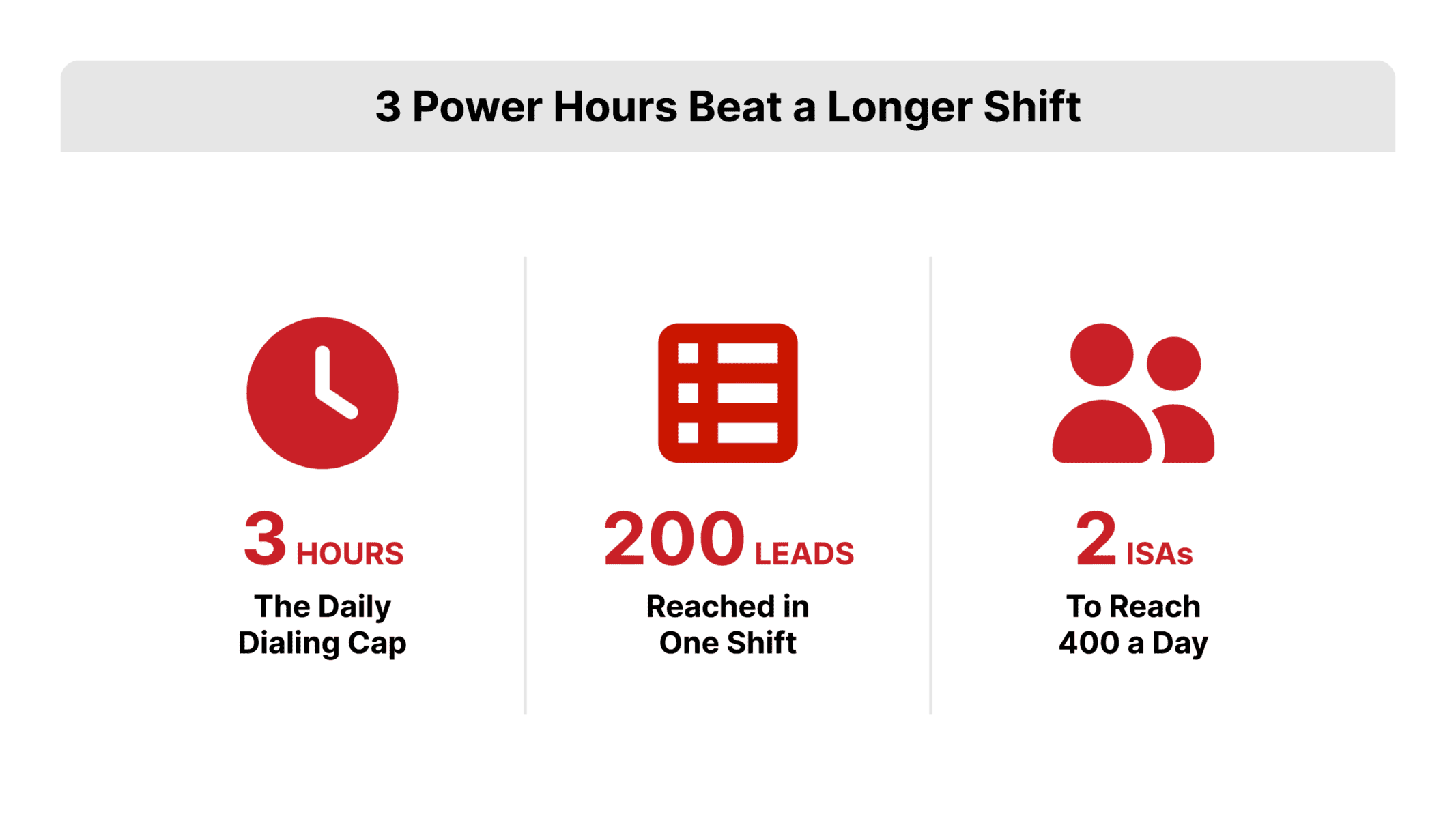
Three, and Jasmine will not sell you more. Agents regularly ask her to extend Helen’s day, and the answer is no.
“We did research. I was a nurse for 20 years. I’m big on research. Three-hour, four-hour, six-hour, eight-hour, and 10-hour days. Any ISA working over three hours is just a waste of time. They are not productive.”
If one ISA reaches 200 leads in a shift, you reach 400 by adding a second ISA. Several of her agents run two, and Cameron’s stated goal is five. “Take my money, give me five of your trained up people who are experienced, and let me follow up with the ones that are hot, and the rest of them we just nurture forever.”
Jasmine points to her own numbers from last month to make the case for a second hire:
“I looked at our GCI for the month of last month and we made 150,000 in GCI for our agents, and I just thought, this makes sense because of the number of ISAs we have.”
Jasmine Lopez, founder of Scalable USA, on the REDX Podcast
What Should You Keep and What Should You Hand Over?
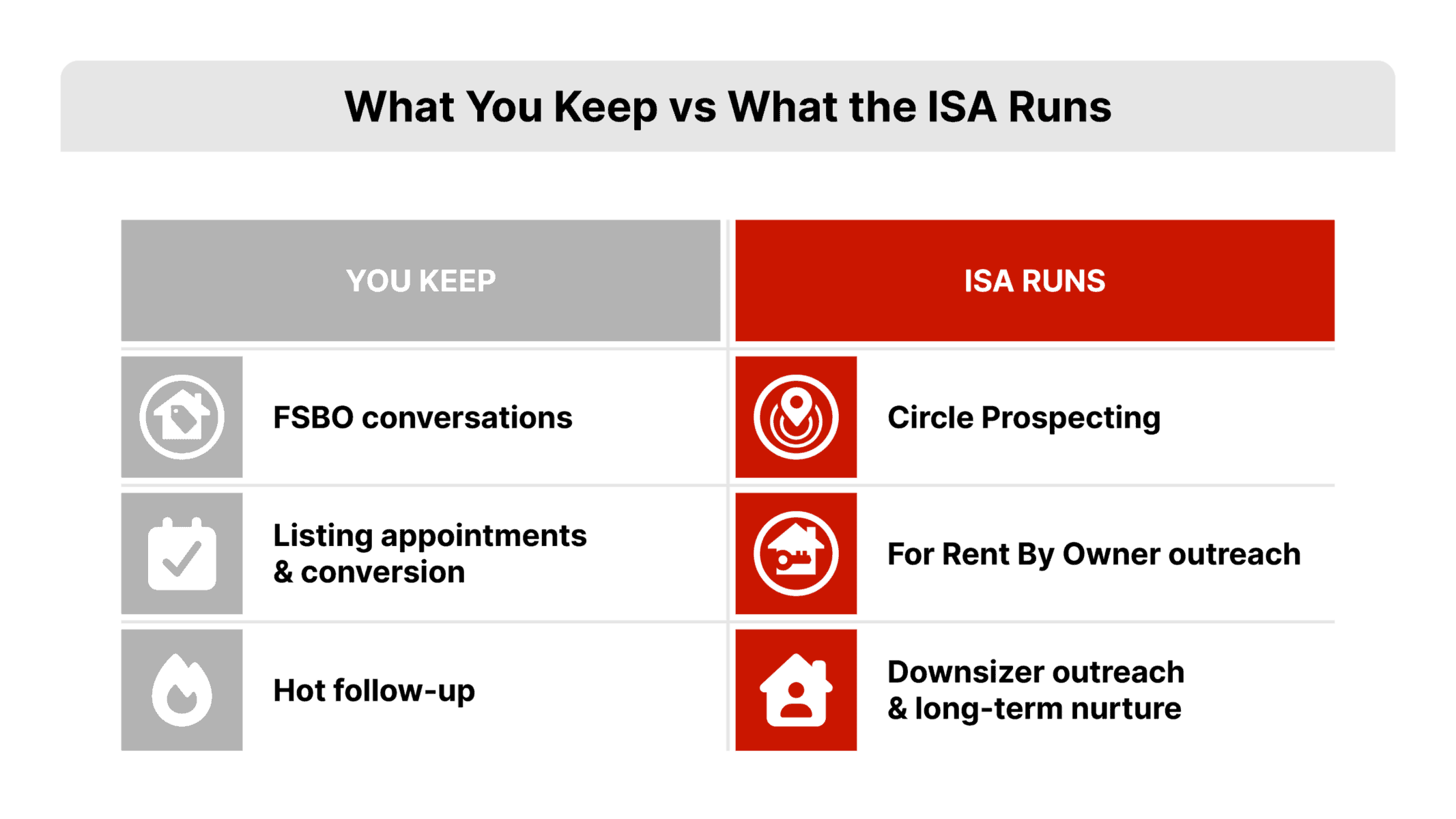
Keep the lead type where your local knowledge is the advantage. Hand over the volume work.
Cameron keeps FSBOs for himself. “I feel like it’s a lot more of a local thing, and I feel like it helps because I know the area.” Helen runs everything else: circle prospecting, for rent by owner, and empty nesters he calls downsizers. That split also matches how these lead types behave over time.
| Lead type | Typical conversion window | Who works it in Cameron’s business |
|---|---|---|
| Expired listings | 30 to 60 days | Fast-moving, agent-facing conversations |
| FSBO | 60 to 90 days | Cameron, because it is local and relationship-driven |
| GeoLeads and circle prospecting | 90 to 120 days or longer | Helen, as database building |
| For rent by owner | Ongoing, tied to lease dates | Helen, tracked to expiration |
The rental angle is Cameron’s favorite carryover from his insurance days. He knows which leases end and when. “Me and Helen have tasks for next November. The lease is going to end at this townhome down here. We know whose tenants are leaving. It’s almost like the insurance world. We know when their expiration dates are coming up.”
How Long Before an ISA Produces a Listing?
Plan on months, and be honest with yourself about which end of the range you can afford. Jasmine has a name for the agents who cannot: commission breath.
“A lot of agents will come and they’ll say, okay, I need an ISA. How long before my first listing?” she says. “One of the things we have to start with is understanding that this data is not an ad. It’s not someone raising their hand saying, please call me because I’m looking to sell my house tomorrow. This is random. That’s why it’s called cold calling and not hot calling.”
Her framing of the answer rate, and of what happens to owners who quit early:
“Industry wide, people who do cold calling know this. The average is 80 to 90% of calls don’t get picked up, but that’s where the consistency comes in.”
“80 to 90% of business owners fail in their first five years because they don’t fill their sales pipeline. Those who understand filling their pipeline are going to survive.”
Jasmine Lopez, on the REDX Podcast
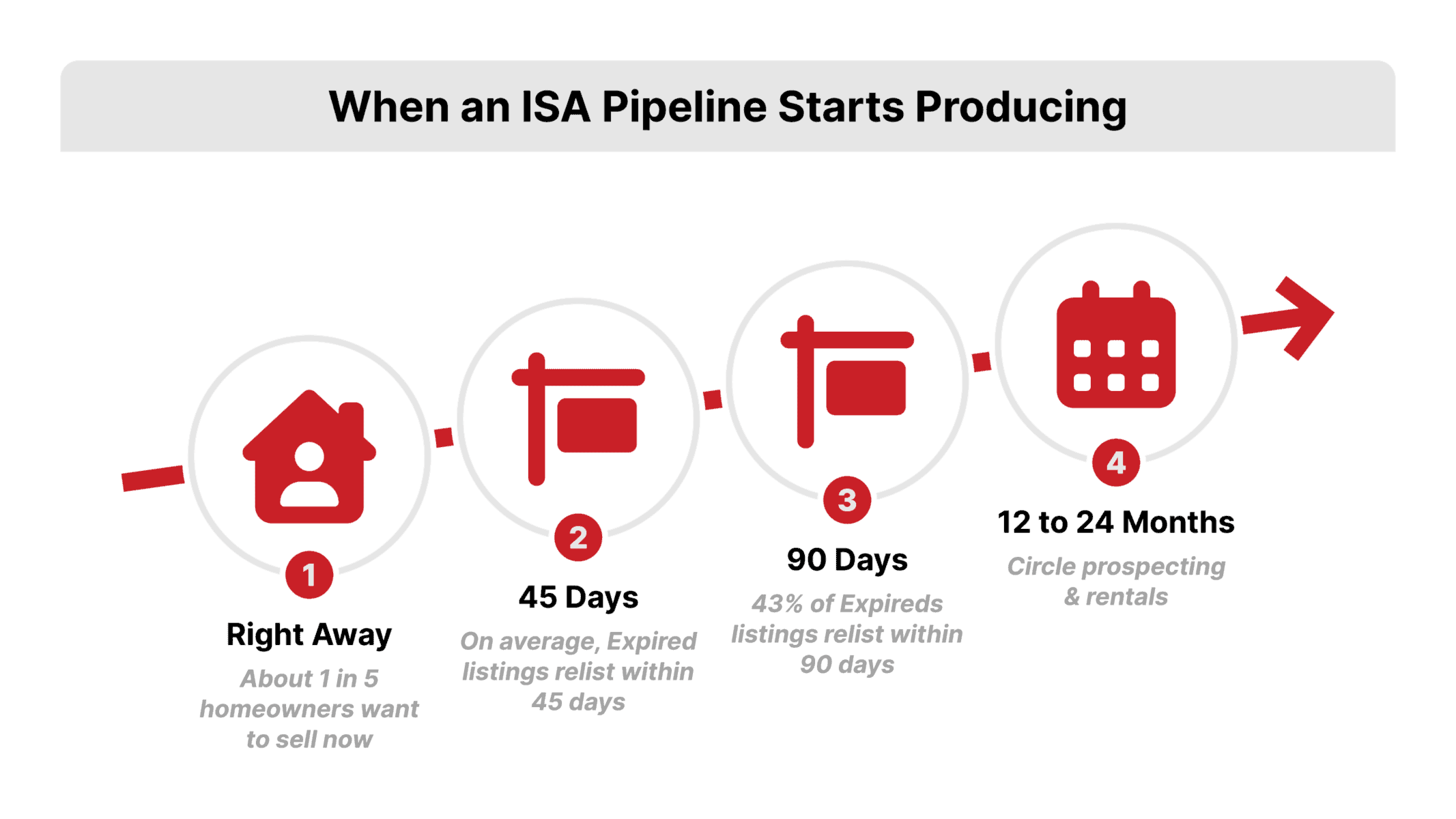
Her honest spread is 3, 6, 12, or 24 months, plus the roughly one in five homeowners who turn out to want to sell now. REDX MLS tracking data gives you a firmer anchor on the fastest lead type: 43% of expired listings relist within 90 days, with an average relist around 45 days. For more insights into how long you should run this spread, check out our timeline breakdown of how long it takes to get results with REDX by lead type covers the rest.
Cameron’s word for the moment it clicks is pipeline maturity. “Once you have pipeline maturity, the game seems a little bit easier, because you’ve talked to these people nine months ago. And not only have you talked to them, you’ve talked to 40 of them. And so has Helen.” He can also feel the reverse. “If I go a couple weeks and I get lazy, I can see my pipeline gets weaker.”
What Does the Follow-Up Look Like for a Seller 18 Months Out?
It looks like being useful on a schedule. When Helen finds someone who plans to move in a year, Cameron treats the gap as the opportunity: “Now we got 12 months to 24 months to become their friends and figure out how we can help them.”
His mix is deliberately unglamorous:
- An online market analysis up front, then automated home value updates so the seller sees what is selling nearby.
- Monthly or quarterly mail that carries a story. Pictures of his wife and son, T-ball season, then a line about scanning a QR code for a home valuation.
- Dated tasks in the CRM tied to real events, like a lease ending next November.
- Social media as reinforcement, so the person he calls already recognizes him.
“Land, sea, and air, stay in front of people, and bring some information to them that they can’t find online,” is how he sums it up. Most agents quit before the seller is ready. Our guide to building a real estate lead follow-up system is built to close that gap.
Your First 90 Days With an ISA
If you are close to hiring, this is the order that keeps the first quarter from turning into a training project.
- Pick the lead types you are handing over and the one you are keeping. Write it down before anyone dials.
- Set the data strategy for your market. Heavy absentee ownership, a big rental pool, or a hot new-construction pocket should change the list mix.
- Build the tagging in your CRM first. One saved view of the ISA’s leads with notes and dated tasks, so your daily routine is a single click.
- Cap the shift at three hours and hold the ISA to dial counts and appointment numbers.
- Define your own conversion job. Decide what you do within an hour of an appointment being set, and what happens on day 2, day 7, and day 30.
- Judge the hire at 90 days on pipeline. Count conversations, dated follow-ups, and appointments held. Listings from a cold pipeline show up later.
- Add the second ISA when your calendar is the constraint. Keep the first one’s shift where it is.
Jasmine’s reason for building the company is the same reason Cameron hired her. She spent 20 years as a nurse and started Scalable USA as a single mom to free up time with her kids. “At the end of the day, when you look at the goal here, the goal is to scale your business to create more freedom in your life,” she says.
Cameron used to feel guilty about a Wednesday morning golf game or being in the pool with his boys at 5:30. “Now I don’t feel guilty, because I am working at the same time that I’m doing things with my son and my wife. Sometimes I’ll tell myself, man, you got to get to work. Then I realize, oh, I have been working. Helen’s been on the phone for two hours.”
Key Takeaways
- A real estate ISA multiplies a prospecting habit you already have. If you are not calling now, hiring someone to call for you will expose the follow-up gap.
- Cap the dialing shift at three hours. Jasmine’s research across 3 to 10-hour days found productivity falls off after three, so add a second ISA when you want more volume.
- Keep the lead type where your local knowledge wins. Cameron keeps FSBOs and hands circle prospecting, for rent by owner, and downsizers to his ISA.
- Judge the hire on pipeline at 90 days. Expireds relist in about 45 days on average, while circle prospecting and rental leads can take a year or more to mature.