Skip to content
 Most agents plan a mail campaign backwards. They pick the postcard first, then look for people to send it to. REDX president and CMO Curtis Fenn has spent more than 15 years in marketing and messaging, and he starts everywhere else: who to send real estate postcards to, and where those people can be reached. The card is only the delivery method.
The reason that order matters is really just math. Homes turn over at under 3% a year nationally, 2.77% in Redfin’s latest count, so a card mailed to every door in a zip code reaches roughly 97 people who were never going to sell this year. Mail to homeowners who already have a reason to move, and the same budget starts buying conversations.
Here is how Curtis picks the list, writes the message, and tracks what came back.

Co-authored by the REDX Publishing Team and:
Preston Vawdrey
Preston is a digital marketer and entrepreneur, helping agents build marketing strategies that can scale with their business.
Quick Links:
- Why Do Postcards Still Work in a Digital Market?
- Who Should You Send Real Estate Postcards To?
- Why Not Mail the Whole Zip Code?
- How Do You Write a Postcard That Actually Gets Read?
- How Do You Know Whether the Campaign Worked?
- Should Every Postcard Use a QR Code?
- Do Postcards Work on Their Own?
- Build Your First 100-Piece Campaign
Watch the full conversation:
Why Do Postcards Still Work in a Digital Market?
Because the mailbox is one of the last places an agent can get near total attention. Curtis points to reporting in Forbes that puts the average American’s daily exposure somewhere between 4,000 and 10,000 advertisements. Our brains adapt by filtering almost all of it out.
Physical mail sits outside that filter, and the volume has thinned. “You just don’t get the junk mail that you did 15 years ago,” Curtis says. “When you have a few pieces of mail, your exposure rate is near 100%. Even if somebody’s looking at it on the way to the garbage, your exposure rate is near 100%.”
He also points to research on what sticks afterward. Canada Post’s 2015 neuromarketing study, A Bias for Action, measured unaided brand recall at 75% after a direct mail piece and 44% after a digital ad.
“Somebody’s ability to retain that information, to break through that filter that our brain is ignoring so much stuff, is higher with direct mail than it is on digital.”
Curtis Fenn, REDX president and CMO.
The behavior is easy to check on yourself. You look at every piece, front and back, on the way to the recycling bin. That glance is the whole opportunity, which is why the list and the first line of copy carry the campaign.
Who Should You Send Real Estate Postcards To?
Homeowners with a visible reason to sell in the next few months. Curtis works from signals of motivation, and five mailing lists carry those signals reliably enough to earn the postage.
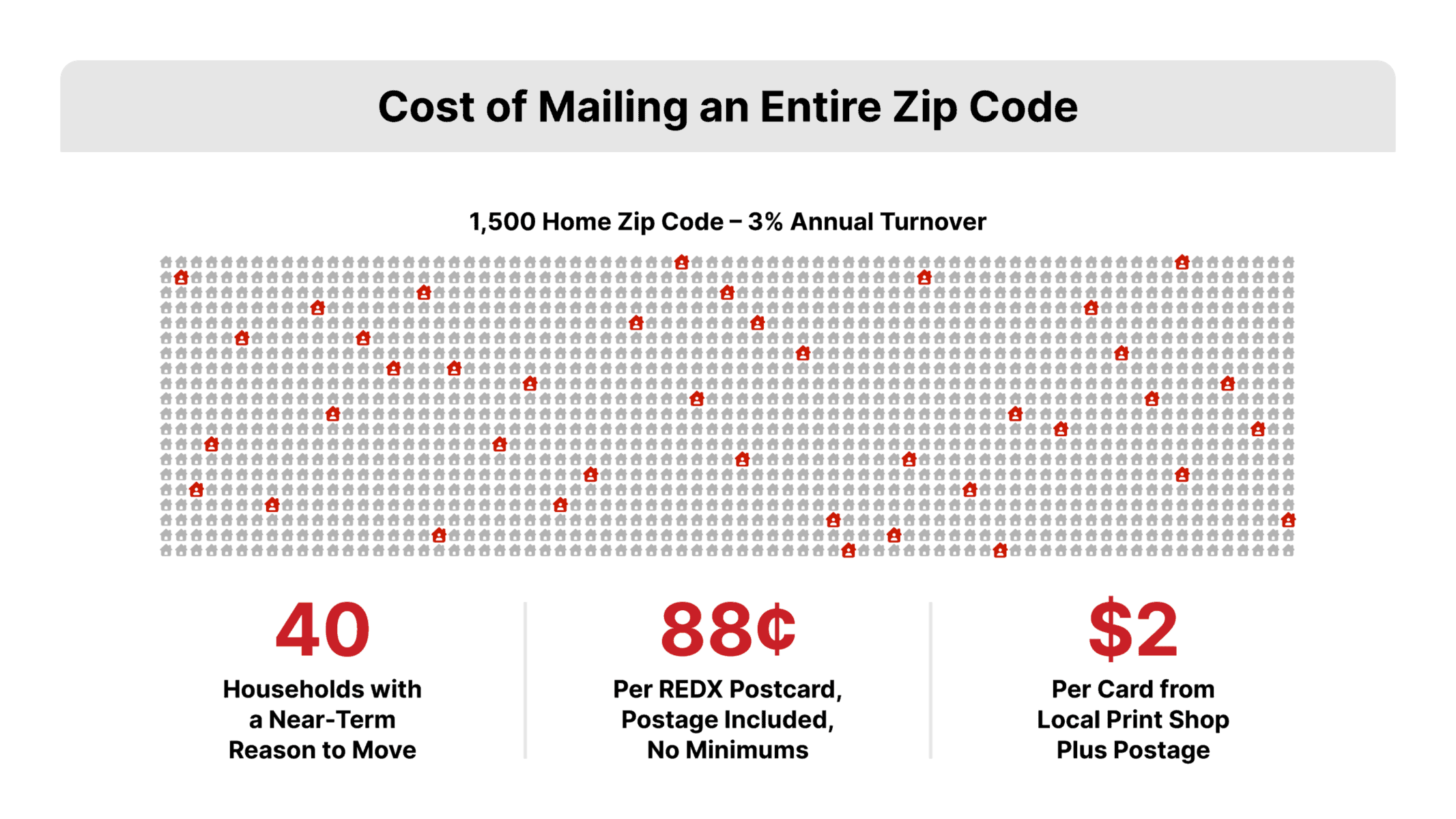
The 5 Mailing Lists Worth Sending Postcards To
- Expired listings. They already hired an agent and the home did not sell. According to REDX MLS tracking data, 43% of expired listings relist within 90 days, and the average relist happens around 45 days out.
- For sale by owner (FSBO). They are selling publicly, with no agent and a growing list of complaints about the process. REDX MLS tracking data shows 88% of FSBOs use an agent in some capacity before the sale is done.
- Just listed and just sold neighbors. A sign down the street is the moment neighbors start wondering what their own home is worth. A card that shows the nearby result answers that question while it is fresh, and GeoLeads pulls the homeowners around any address.
- For rent by owner (FRBO). Landlords managing their own rentals are often worn down by tenants and turnover. A card that puts a sale on the table reaches them before they sign the next lease.
- Pre-foreclosures. A deadline is doing the motivating. About 15% of pre-foreclosure leads relist each year, and these owners respond to a quieter, more private call to action.
Two more signals sharpen any of those lists. Absentee owners do not live in the property, which loosens the emotional attachment. Long tenure or a space mismatch, like 3,000 square feet occupied by two people, points to a lifestyle change, so layer both on as filters and the list gets smaller and warmer.
“All of those things are signaling a lifestyle change or something that’s happening,” Curtis says. “It means they’re closer to a decision to sell their home, which is where you would want to put a postcard in front of them.” His closing line on the subject is the shortest version of the rule: “If I’m selling steaks, I should not waste my time marketing to vegans.”
Why Not Mail the Whole Zip Code?
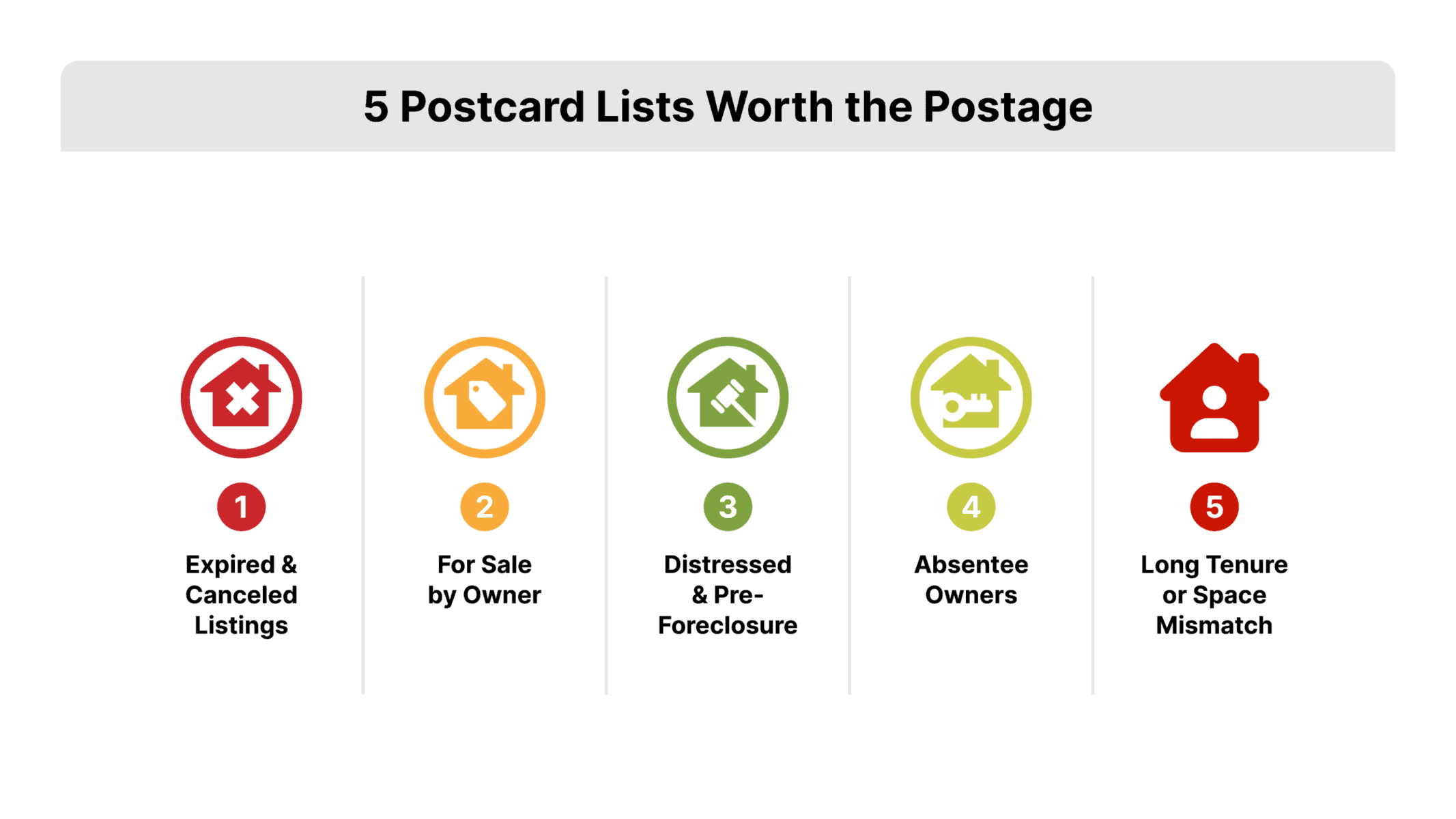
Because the cheap-per-piece math stops being cheap once you divide by responses. Say your zip code holds 1,500 homes. At a dollar a card you have spent $1,500 to reach roughly 40 households with any near-term reason to move, and every one of them got the same generic message.
Pricing varies more than agents expect. A local print shop can land near two dollars a card once postage is added on a run of 100. A dollar is common. Inside REDX, postcards are a Vortex feature at 88 cents a card with no minimum, so a 100-piece campaign to a filtered list runs $88.
You can beat that per piece with high-volume bulk printing, and Curtis is direct about the tradeoff: bulk means the same card goes to everyone, and you lose what makes mail measurable: personalization and per-property tracking.
How Do You Write a Postcard That Actually Gets Read?
Say something the recipient is already thinking about. Relevance beats design, and relevance means naming the emotional moment the homeowner is in.
Curtis draws the comparison to why social feeds hold us: the content that breaks through either makes us angry or validates something we already feel. Mail works the same way. The card that stops the walk to the trash can speaks to a specific frustration.
Use their own complaints as your copy
For FSBOs, the research already exists. NAR publishes a field guide on working with FSBOs that collects the most common problems and complaints of people trying to sell without an agent. Take that list, feed it to an AI tool, and ask for postcard lines that speak to the top few. Curtis’s examples:
- “Are you tired of letting strangers in your home?”
- “Are you trying to sell your home but still concerned about the paperwork?”
Both name a problem in the top 10 reasons FSBOs eventually hire an agent, which is what earns the flip to the back of the card.
The expired card Curtis likes best
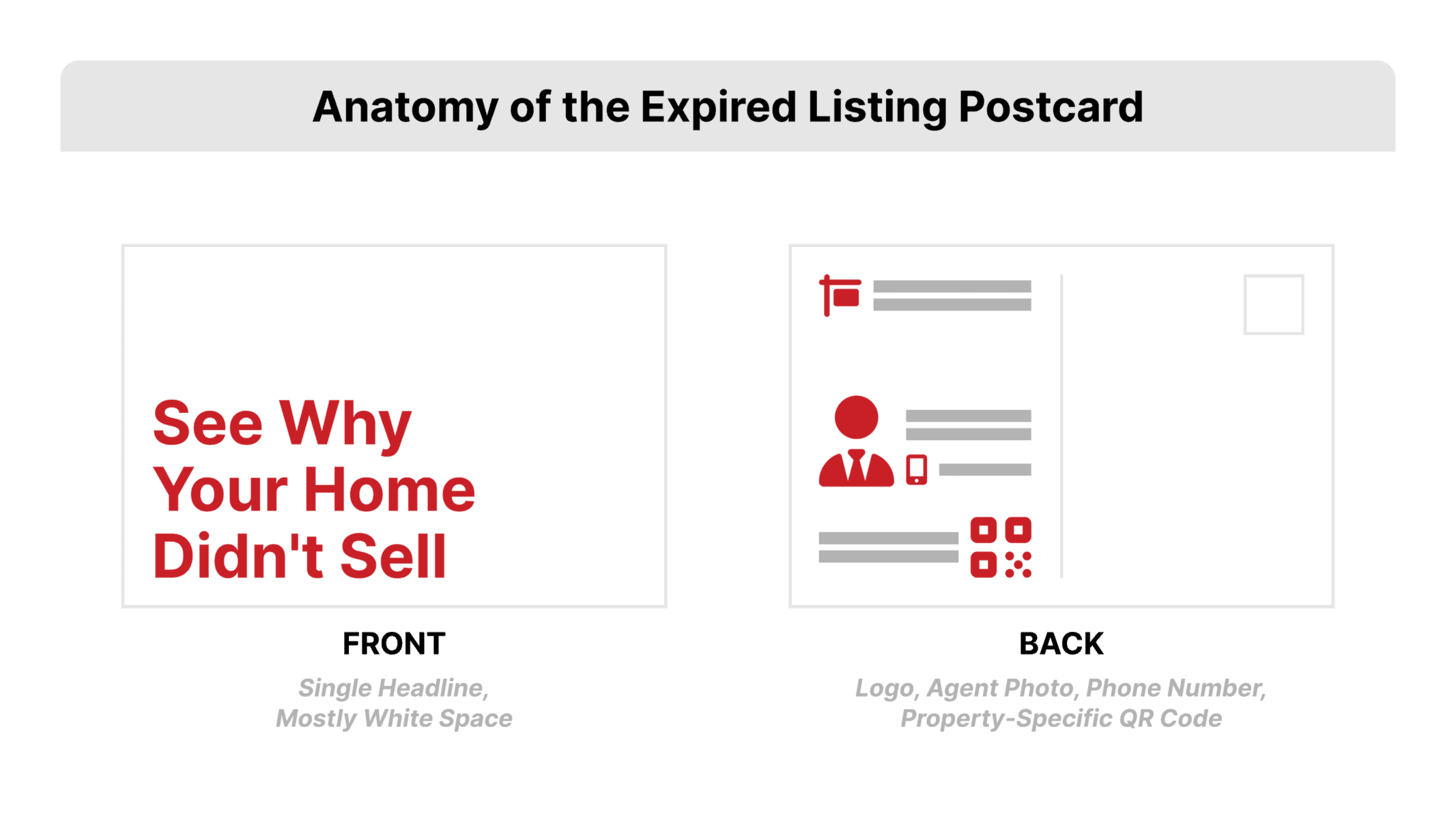
Mostly white space, with one line in large type: See why your home didn’t sell. That is the entire front. The back carries the agent’s photo and logo. A phone number and a large QR code round out the design.
Timing is what makes it land. In the first 10 days after an expiration, the sign is coming out of the yard, other agents are calling, and the homeowner is explaining to everyone why they have not moved yet. A card that offers an explanation with no pressure fits that moment better than a pitch does. For more designs built around that window, see our expired listing postcard ideas and free templates. Our library of high converting postcard templates covers the other lead types.
How Do You Know Whether the Campaign Worked?
Put something on every card that identifies the property it went to. Curtis’s default is a QR code generated per address.
When a scan comes in, you know exactly which house acted. Inside REDX, that scan triggers an alert in Vortex, and the card links to a pre-written personalized report. In the expired version, the report walks through the reasons homes fail to sell and positions the agent who mailed it, with that agent’s photo and logo pulled in automatically.
A scan also tells you something about the relationship. Curtis raised the point carefully, hedge attached: he’s not an attorney, and an attorney told him a scan can indicate a business relationship, which may affect which channels you can use for follow-up. Treat that as a question for your own counsel, and keep dialing rules separate from mail rules. REDX recommends agents avoid calling numbers on the Do Not Call list, and our agent’s guide to the DNC list and TCPA covers the current requirements.
Should Every Postcard Use a QR Code?
A QR code is the lowest-barrier way to track a specific person’s behavior, so it’s a safe default on any campaign. The exception is emotional weight.
“What if the emotional moment that you’re looking for is probate or divorce?” Curtis asks. “What if the emotional moment that you’re trying to tap into is distress and foreclosure? You might want to have a more intimate call to action.” In those cases a phone number invites the human contact the situation calls for, and you accept the tracking loss as the cost of the right approach.
Do Postcards Work on Their Own?
They work as one layer of several touches on the same list. Send 100 cards and you won’t get 100 scans, the same way 100 dials don’t produce 100 conversations.
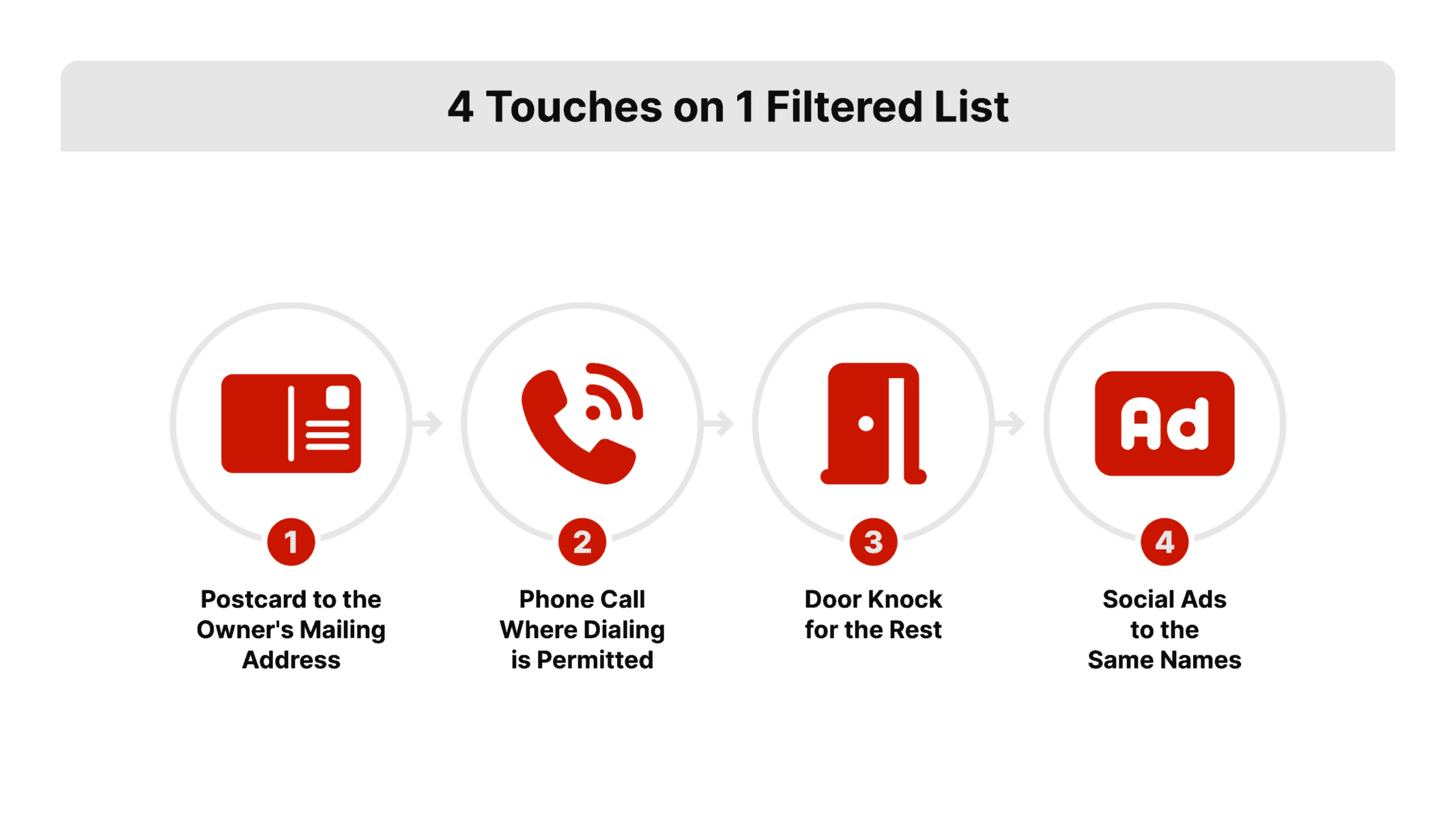
The compounding comes from stacking channels on one filtered group of homeowners:
- Mail the card to the owner’s actual mailing address, which matters for absentee owners who never see the property’s mailbox.
- Call the ones you can legally call, and knock the doors of the ones you cannot.
- Run social ads to the same list so your face and logo show up between the mail and the call.
- Let the scans reprioritize your day. A homeowner who scanned yesterday is worth today’s first call.
None of the channels is impressive alone. Together they make you one of the two or three agents a frustrated seller can actually name when they decide to relist. Expired listing data is the natural first list to run this play on, because the relist window is short and the motivation is already there.
Build Your First 100-Piece Campaign
You can have this in the mail today, and the budget is smaller than most agents assume.
- Pick one list, not four. Expireds are the easiest first run because the timeline is measurable in weeks.
- Filter it down. Narrow by price band, neighborhood, or days since expiration, so the message can stay specific.
- Name the emotional moment that group is living in. Put it in one sentence before you open any template.
- Write the front around that sentence and leave the rest of the card mostly empty.
- Add per-property tracking so you know which address responded.
- Send 100 cards and write down the date. At 88 cents a card, that’s $88 committed.
- Stack the other touches across the next two weeks. Call the ones you can legally reach, knock the doors of the ones you can’t, and run social ads to the same names.
- Review at 30 days. Count scans and conversations, then decide whether the list or the message needs the next revision.
Curtis’s summary applies well beyond mail. Put your time and energy, plus your advertising dollars, behind the people who are close to transacting. The postcard is just the version of that idea that fits in a mailbox.
Key Takeaways
- Choose the who before the card. With home turnover under 3%, a full zip code mailing pays postage on roughly 97 households with no reason to move this year.
- Five lists earn the spend: expireds, FSBOs, just listed and just sold neighbors, FRBOs, and pre-foreclosures. Absentee ownership and long tenure sharpen any of them.
- Relevance is the whole message. Name the frustration the homeowner already feels, using their own common complaints as your copy.
- Track by property. A QR code tied to the address tells you which house responded, and at 88 cents a card a 100-piece test costs $88.