Skip to content
 Key takeaways
- Real estate SEO works, but it is slow. Plan on 1 to 1.5 years before it pays off, not next month.
- Agencies typically start around $1,000 a month; doing it yourself costs time and keyword data instead.
- A strong Google Business Profile and local keywords matter more to most agents than chasing national rankings.
- Track three numbers: impressions, clicks, and leads generated.
- SEO should support your prospecting, not replace it.
Every real estate agent has asked some version of the same question: does real estate SEO actually work, or is it just another marketing buzzword? To get an honest answer, REDX sat down with Preston Vawdrey, who manages SEO for REDX.com and for several of his own real estate clients.
We combined the questions agents ask most often, pulled straight from real search data, with a few pointed follow-ups of our own. Here is his unfiltered take, question by question.

Co-authored by the REDX Publishing Team and:
Preston Vawdrey
Preston is a digital marketer and entrepreneur, helping agents build marketing strategies that can scale with their business.
Quick Links:
- Does real estate SEO actually work, or is it oversold?
- What is real estate SEO, in plain terms?
- Is real estate SEO worth it for a solo agent or small team?
- How long does real estate SEO take to show results?
- How much should you budget for real estate SEO?
- Should you do your own real estate SEO or hire an agency?
- Does local SEO matter more than ranking nationally?
- How do you know if your real estate SEO is working?
- What’s the difference between blogging and technical SEO?
- Should real estate SEO replace your prospecting, or support it?
Does real estate SEO actually work, or is it oversold?
Yes, real estate SEO works, but only if you treat it as a long-term investment, not a fast lead source. People still search Google for their questions, and AI tools like ChatGPT pull most of their answers from websites and Google search results. If you do not show up there, that information about you simply does not exist to a homeowner doing research.
Building that visibility takes real investment, in your website, your brand, and your reviews, sometimes over a few years. So is it oversold? Maybe. SEO rarely lands in the top five strategies agents mention when asked how they get business. But if you are a broker, a team, or an agent with a few years in the business and you still do not have a website, that is a real gap. Nearly half of buyers say they start their home search online, according to NAR research, and people vet agents the same way they vet any purchase. Without a site showing your listings and reviews, you are invisible in that search.
What is real estate SEO, in plain terms?
Real estate SEO is the ongoing process of updating your website and your Google Business Profile so search engines, and now AI tools, can find you and recommend you to homeowners. That definition has shifted with the rise of AI search, and terms like AEO and AIO now get used inconsistently across the industry.
The simplest way to think about AI optimization is as a layer of data enhancement on top of your website that helps large language models understand your content. That includes things like schema markup and writing your headers as questions with clear answers underneath them, similar to the format of this article.
Is real estate SEO worth it for a solo agent or small team?
It depends more on your time and budget than the size of your business. SEO and AI optimization tend to make more sense for larger organizations. Most small teams and brokerages get a faster return from traditional prospecting or paid lead sources instead.
Part of the reason is cost. Keyword research and data can run a couple hundred dollars a month, and the skill set to optimize a website well can be expensive too. It often takes a working knowledge of JavaScript, HTML, and CSS, plus creative writing, browser rendering, and detailed keyword research.
That said, I am a firm believer that anyone can learn SEO, especially alongside a paid AI subscription like ChatGPT or my personal favorite, Anthropic’s Claude Pro. Those tools are lowering that skill barrier fast, so if you have spare time and a modest budget, SEO is worth exploring.
Most people who start down this road eventually give up and hire an agency to handle fairly basic work, and those agencies can get expensive. I would not recommend hiring an SEO agency for most small teams or brokerages unless you have a 12-month runway you are ready to commit, either to paying that agency for a full year or to learning real estate SEO yourself.
How long does real estate SEO take to show results?
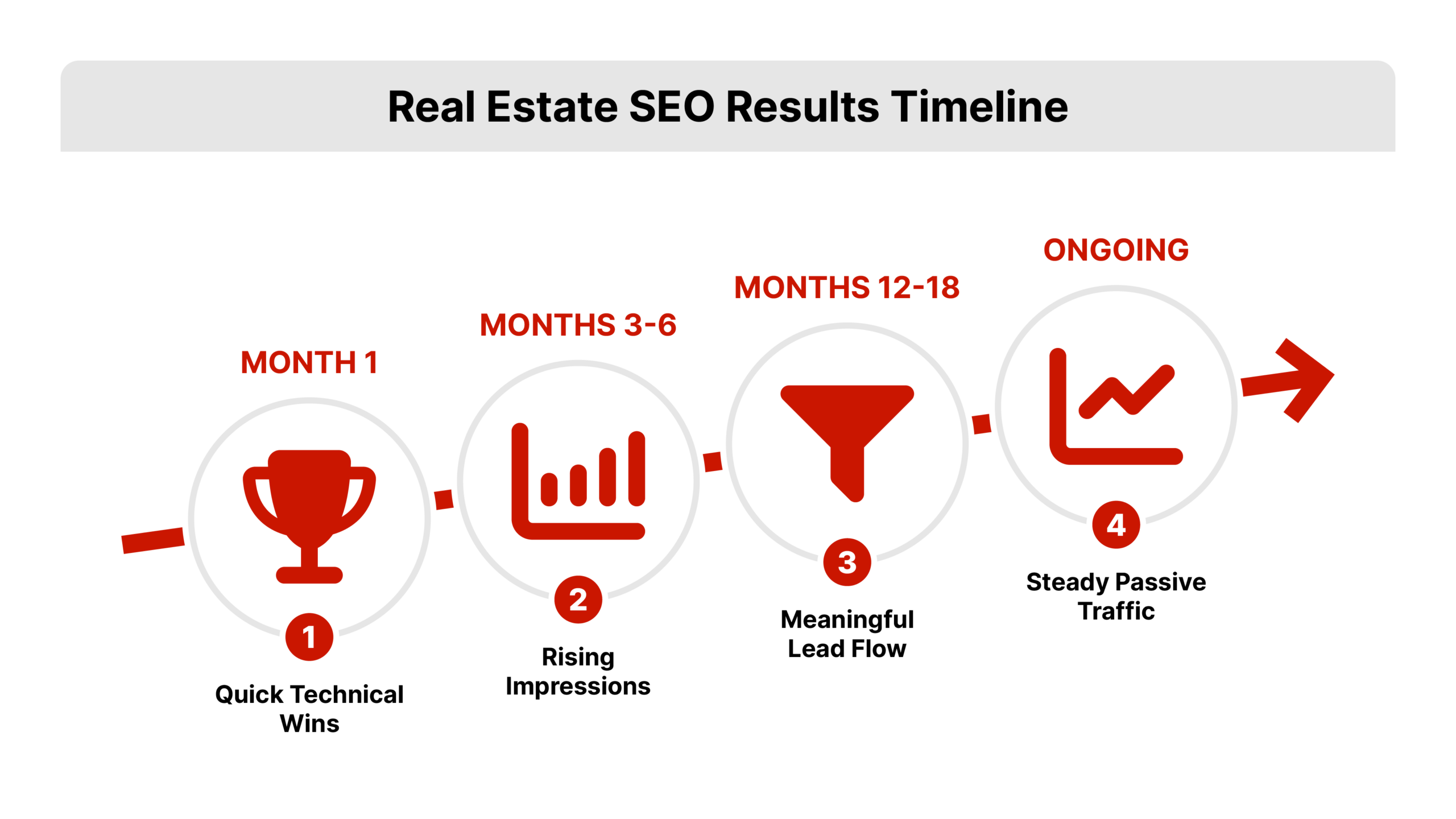
Plan on 1 to 1.5 years before SEO meaningfully pays off, though small wins can show up within a month. If someone dedicates real time to quick fixes, strong content, and finding easy opportunities, you can often see real improvements to your discoverability within the first month.
Keep in mind SEO and conversion rate optimization are two different jobs that need to work together. SEO makes your website easier to find. It does not automatically make people convert once they land on it. Both have to happen for your site to become a real lead generation engine over time.
How much should you budget for real estate SEO?
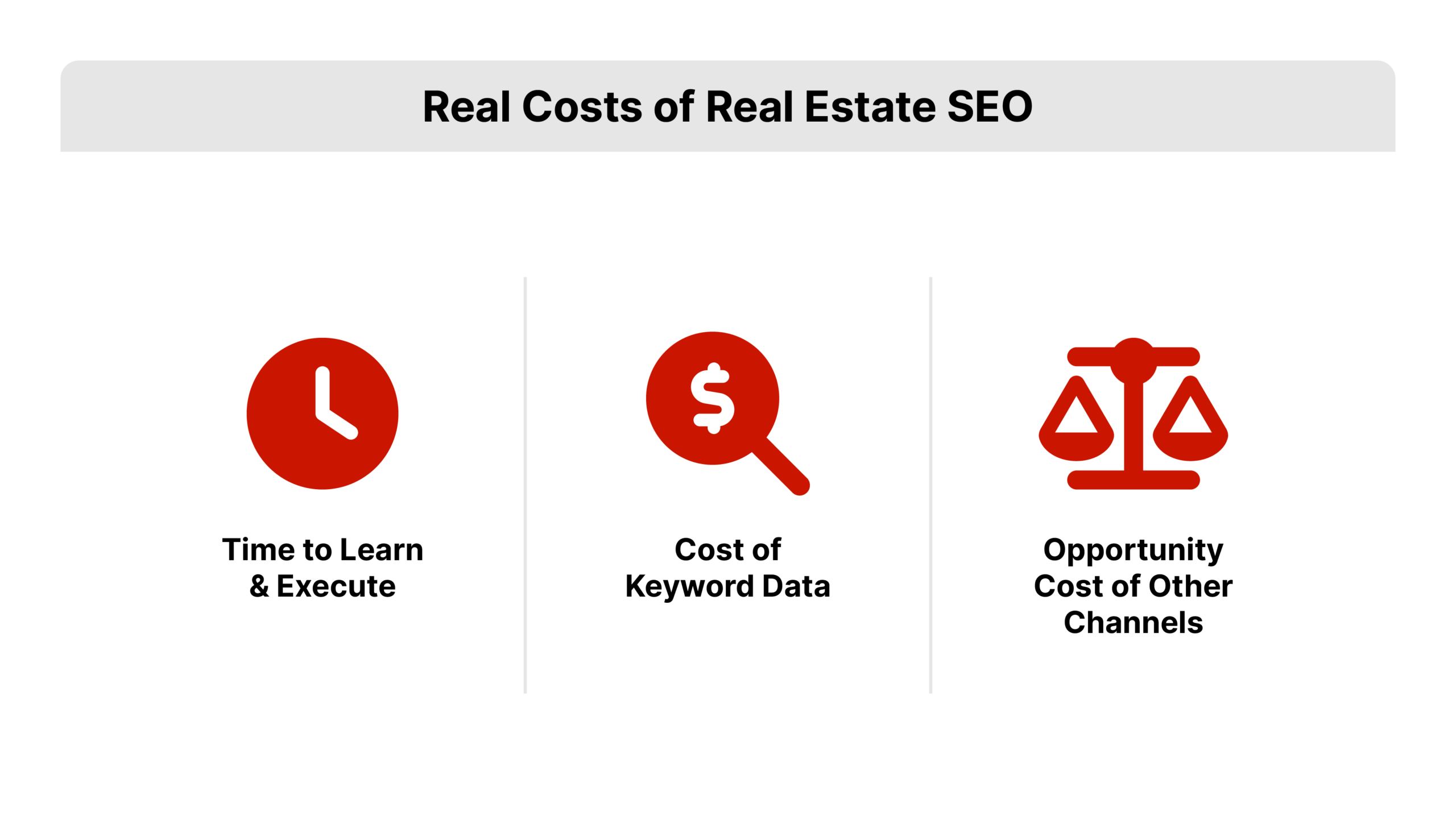
Most agencies I have seen price real estate SEO starting around $1,000 a month, so budget at least that much if you plan to hire one out. If you handle it yourself instead, the two biggest costs are time and keyword data, not a flat price tag. Keyword research is the process of finding search terms worth targeting that have low enough competition for you to realistically rank for them in a reasonable time frame. That data usually costs money, though free methods exist too, like the ones covered in this roundup of free keyword research tools.
The bigger cost is really an opportunity cost. Every hour and dollar you put into SEO is an hour or dollar you are not putting into PPC campaigns, social media, or email marketing. Only you can decide which of those is the better use of your time right now.
Should you do your own real estate SEO or hire an agency?
If you are willing to put in the time, any agent can learn real estate SEO, but expect to make some mistakes along the way. If that trade-off works for you, teaching yourself is usually the more practical path, especially as a solo agent, since hiring an agency can be cost prohibitive at that scale. If you are not ready for the learning curve, hiring an agency instead is a reasonable call.
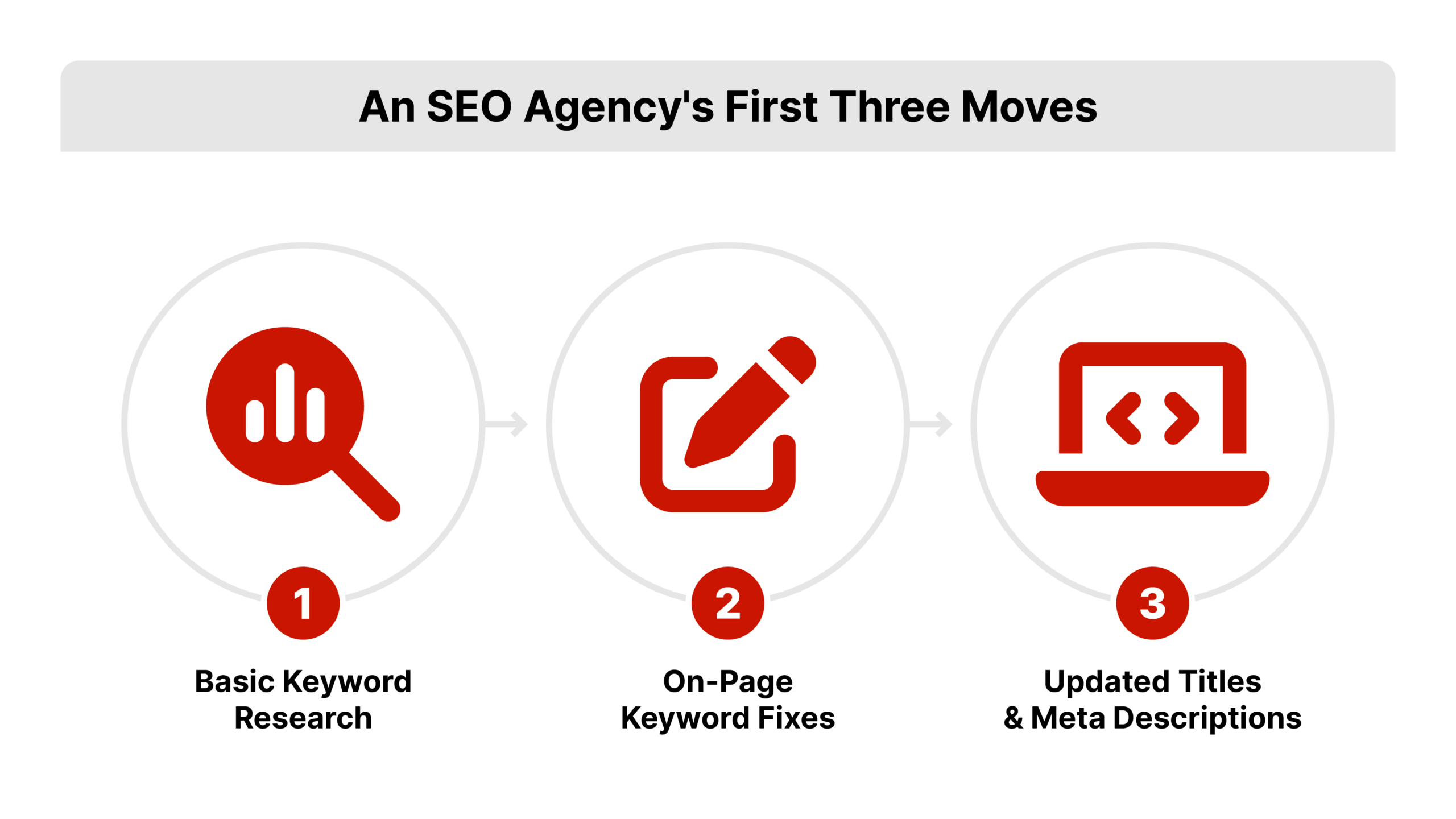
Most agencies start with the same three things: basic keyword research, a list of on-page keyword fixes, and updated titles and meta descriptions across your pages. A new person can usually learn that in a day or two, saving thousands of dollars versus hiring an agency, though it costs two days you are not spending on prospecting. With a willingness to learn and a ChatGPT subscription, most agents can pick up the fundamentals of real estate SEO quickly and start seeing progress just as fast.
For most agents, the best place to start is optimizing your Google Business Profile and collecting reviews from past clients, which delivers more return for less effort than deep keyword work. If you only had two hours to spend on this, start there. And if you are vetting an SEO agency, ask what their weekly or monthly process looks like for reviewing your SEO data.
Does local SEO matter more than ranking nationally?
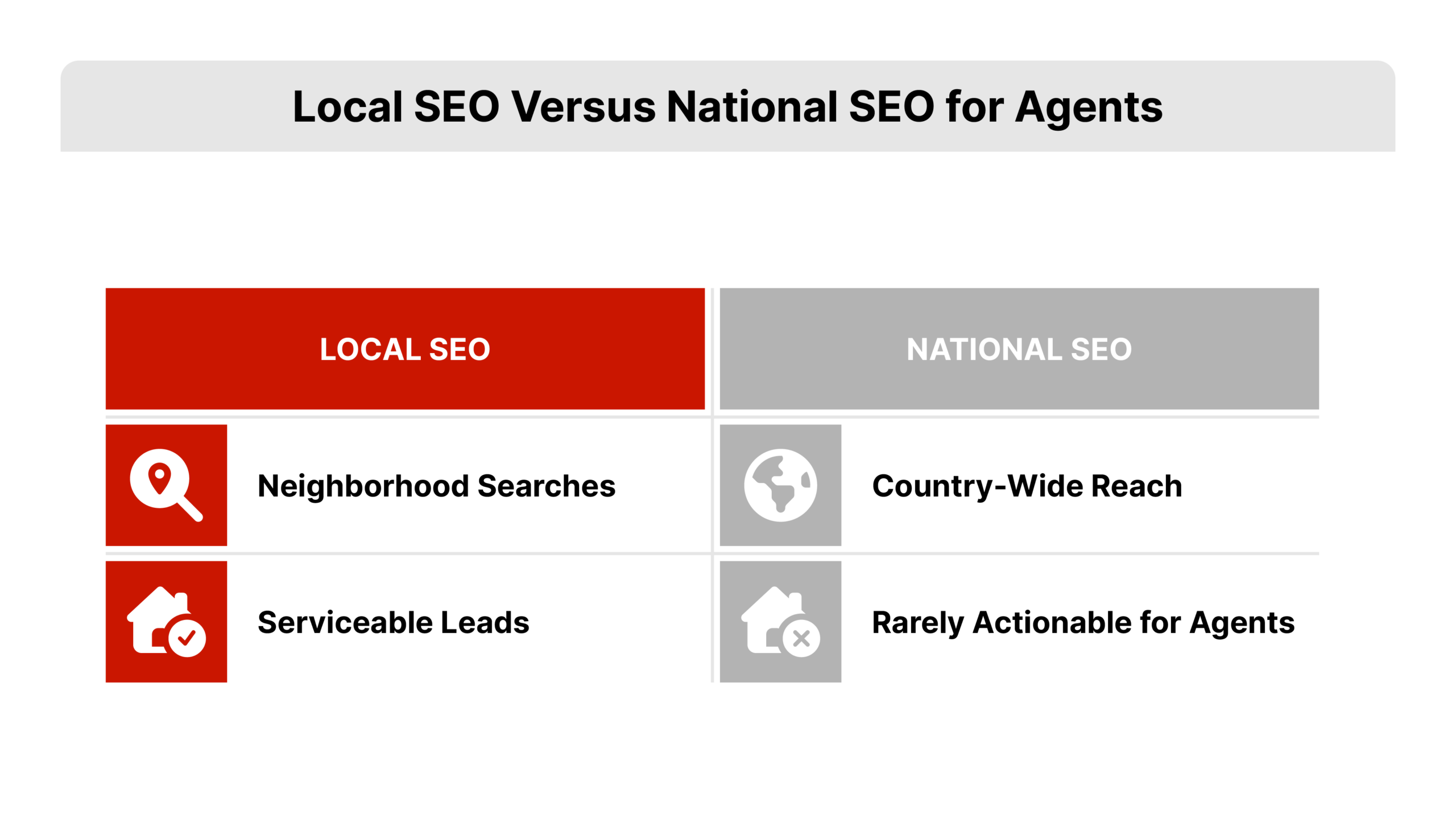
Yes, for almost every agent, local SEO matters far more than ranking nationally. Think about it this way: would you rather have someone reach out to you from across the country, or from your own neighborhood?
Target keywords tied to what is happening in your local market, not national trends, when you build out your real estate SEO strategy. The whole point of it is generating conversations and listings you can actually service, and if you cannot take on deals across the country, ranking nationally does not help you much.
How do you know if your real estate SEO is working?
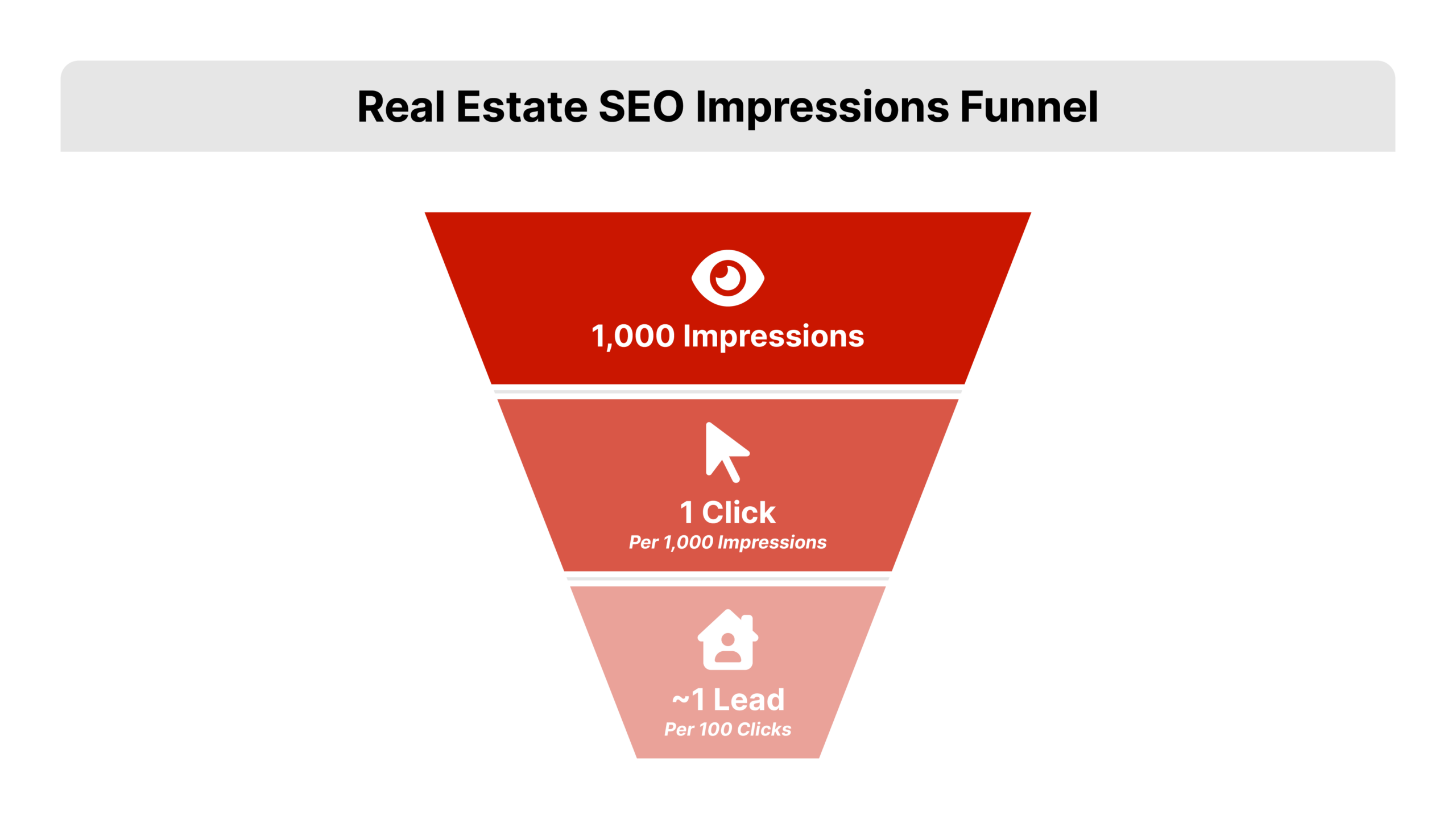
Track three numbers: impressions, clicks, and leads generated. As a rough benchmark, expect around 1 click for every 1,000 impressions, and roughly 1 lead for every 100 clicks. Those numbers can vary by market and page quality, but they give you a starting point.
Organic search also scales in a way most agents underestimate. Websites doing local SEO well can generate thousands of impressions on their pages. Once your domain has built up enough trust, usually over a year or two, SEO can turn into a passive marketing channel that keeps generating leads with little day-to-day effort.
What’s the difference between blogging and technical SEO?
In real estate SEO, blogging targets keywords and questions that do not have a natural home anywhere else on your site. Technical SEO is the behind-the-scenes work that makes your entire site easier to find. Most agent websites already have a natural place for an about page, a listings page, and reviews on a Google Business Profile. A blog fills the gap for content like local market updates that would not fit naturally anywhere else.
Technical SEO covers things like your meta titles and descriptions, a robots.txt file, an llm.txt file so AI tools can read your site, and making sure your pages render properly. It sounds intimidating, but most website builders, including Wix, Shopify, WordPress, and Squarespace, already include these settings. Usually it is just a matter of finding the setting, turning it on, and writing a good description.
If you want a fast start, try a prompt like this in Claude, ChatGPT, or Gemini:
“I am a real estate agent looking to optimize my website for search engine optimization and AI optimization. Research the SEO features built into [your website platform, such as Squarespace, Wix, or WordPress]. Then give me a detailed audit of my website at [your domain], including the quick wins I could complete today in about 15 minutes, and a step-by-step guide for how to make those changes myself in my website editor.”
Do that one 15-minute task every day, and you will start to see steady improvement in your impressions and clicks.
Should real estate SEO replace your prospecting, or support it?
Real estate SEO should support your prospecting, it should never replace it. It can take a long time to turn profitable, and depending on your market, it can be genuinely competitive. Cold calling, door knocking, direct mail, and paid advertising still deserve to be the backbone of most agents’ lead generation.
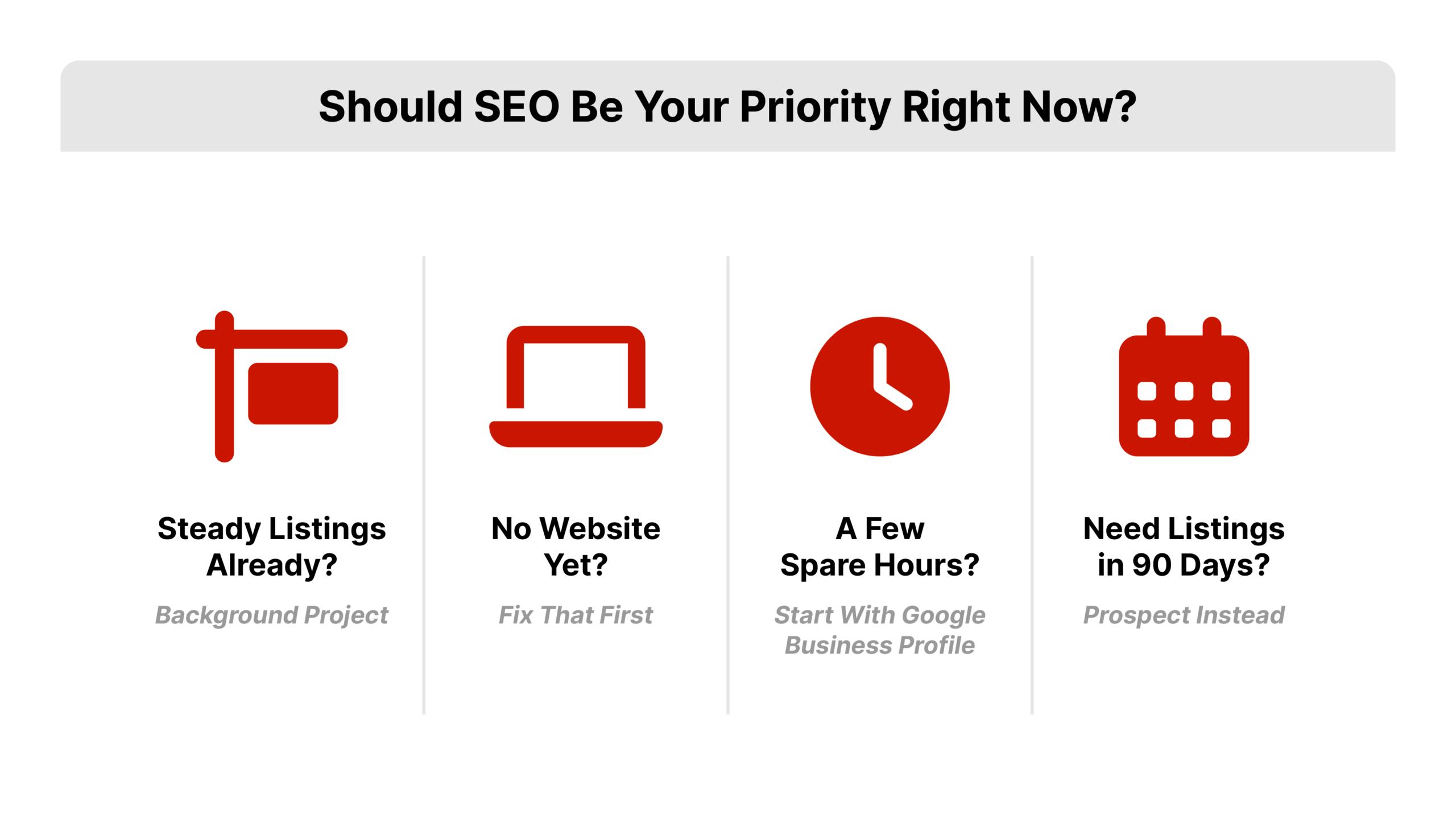
Use this as a quick gut check for where SEO fits in your own business:
- If you already have a steady flow of listings from calls, referrals, or paid leads, treat SEO as a background project, not a priority.
- If you are a broker or team without a website at all, fixing that gap is worth doing regardless of your SEO timeline.
- If you have a couple of spare hours a week, start with your Google Business Profile and reviews before you touch keyword research.
- If you need listings in the next 90 days, put your time into prospecting, direct mail, or paid ads instead.
In my own business, I do not rely on real estate SEO as a primary source of clients, because it is not reliable enough for that. I lean on paid advertising, email marketing, and referral marketing to bring people to my website and generate new business. SEO runs quietly in the background, and I let it do its job on its own timeline.