Skip to content
 The number one reason agents avoid the phone isn’t rejection. It’s not knowing what to say the moment a seller pushes back. Tyler Fenn, REDX’s VP of Training and Education and head trainer at Listing Academy, has heard nearly every version of it: “We’re going to wait.” “What’s your commission?” “I need to talk to my spouse.” Each one can end a call in seconds if you don’t have a plan.
Most real estate objection handling advice tries to win the argument. It hands you a rebuttal designed to prove the seller wrong, and then wonders why the seller digs in harder. This guide covers the framework Fenn teaches: how to overcome objections in real estate by asking questions that lead the seller to talk themselves into the appointment.

Co-authored by the REDX Publishing Team and:
Tyler Fenn
Tyler Fenn is the founder of Listing Academy and a real estate agent actively in production.
Quick Links:
- Why Do Most Real Estate Objection Scripts Backfire?
- What Are the Three Types of Seller Objections in Real Estate?
- How Do You Overcome Objections in Real Estate With the Binary Question Method?
- How Do You Handle Commission Objections in Real Estate?
- How Do You Handle the “I Need to Talk to My Spouse” Objection?
- What Do You Say to Close the Appointment?
- How Do You Turn Objection Handling Into a Skill You Actually Own?
Why Do Most Real Estate Objection Scripts Backfire?
Because they tell the seller they’re wrong, and being told you’re wrong makes you defend your position harder, not soften it. A seller has a belief: about the market, about agents, about their price. A script built to counter that belief puts up a wall, and walls are hard to take down once they’re up.
This isn’t a guess. Psychologist Jack Brehm described it in 1966 as psychological reactance: push on a belief, and people defend it more strongly, whether or not they were right in the first place.
Social psychologist Elliot Aronson’s 1999 work on self-persuasion found the flip side: people act on conclusions they reach on their own far more readily than ones handed to them. Fenn likes to borrow a line from sales trainer Mike Ferry to sum up the shift: “Don’t talk and tell, ask and sell.”
That changes the goal for a prospecting call. Ask the kind of question that lets the objection dissolve on its own, because the seller reasoned their way to the answer themselves.
What Are the Three Types of Seller Objections in Real Estate?
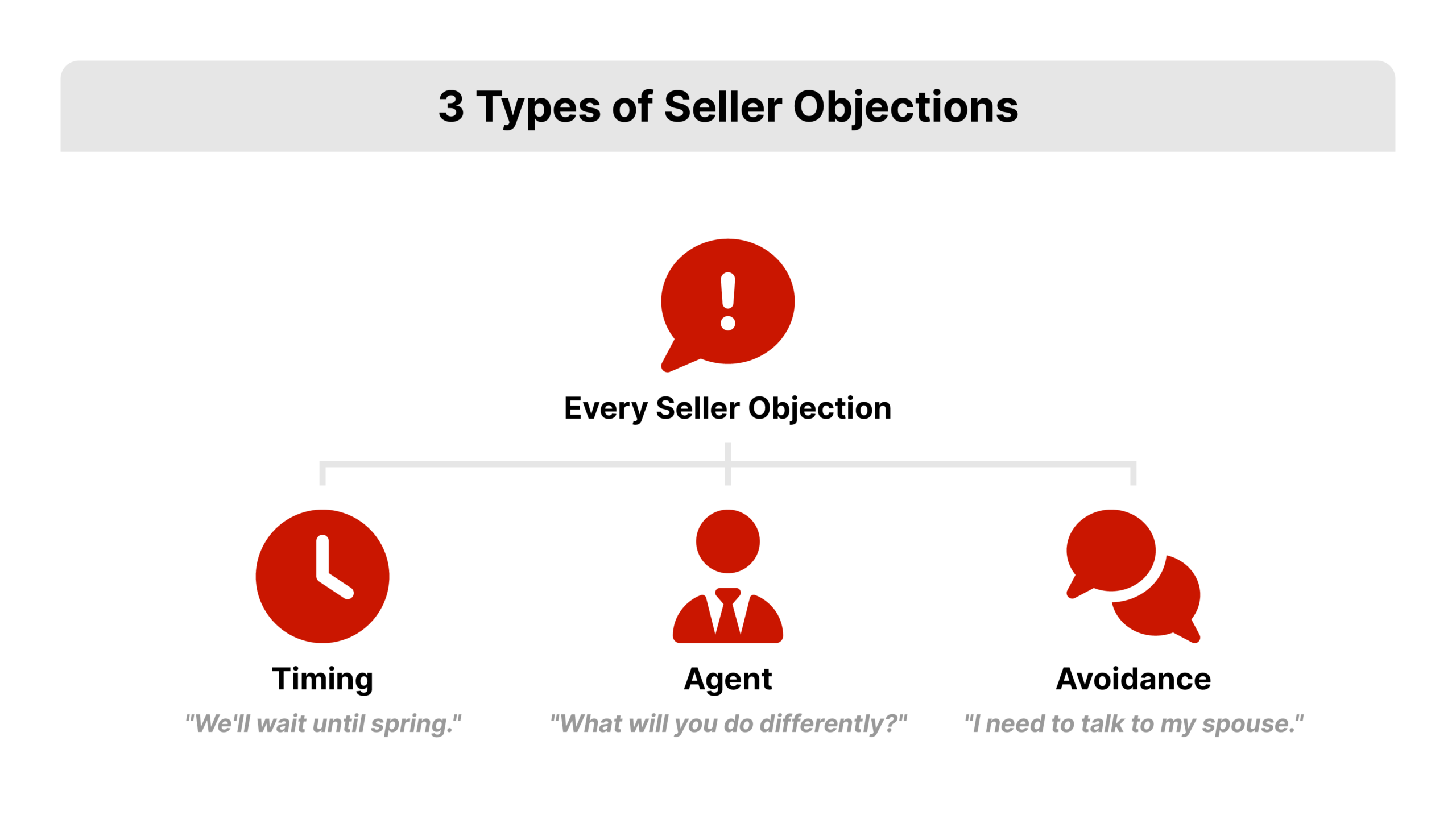
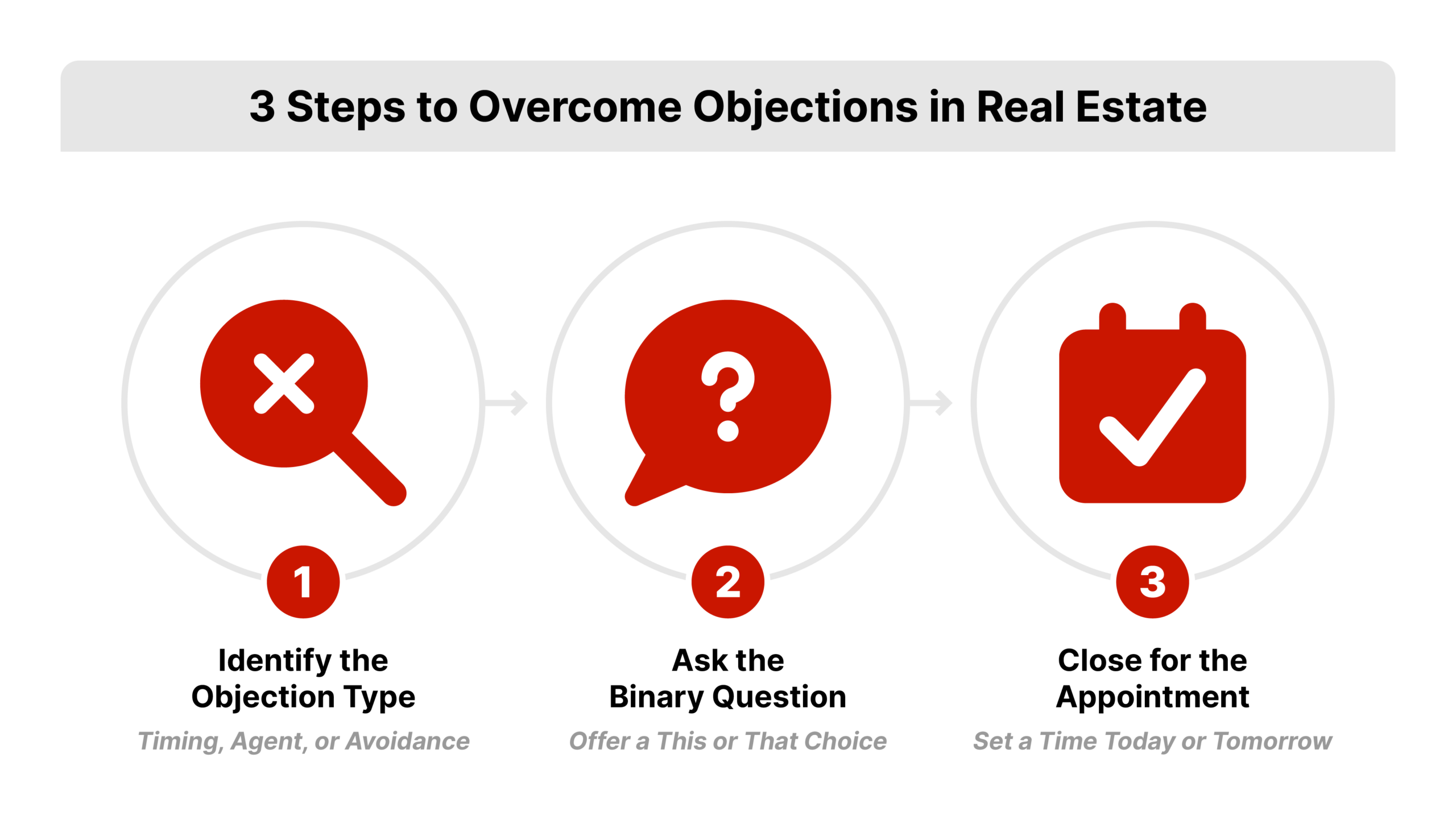
Every objection you’ll hear while prospecting, whether it’s an expired listing, a for-sale-by-owner, or someone in your sphere, falls into one of three groups.
Timing Objections
“We’ll wait until spring.” “We’re waiting on rates to change.” “We’re renting it out instead.” Even the rental answer is a timing objection, since the seller would rather list if the pieces lined up.
Agent Objections
“What are you going to do differently than my last agent?” “We’re listing with my wife’s cousin.” “We’re going FSBO.” The seller needs to sell. They’re just unsure whether you, or any agent, are the one to do it.
Avoidance Objections
“I need to talk to my spouse.” “How did you get my number?” These aren’t really objections. They’re an attempt to end the call, the same move you’d use on a telemarketer because you know it works.
Once you know which bucket an objection falls into, the response gets simple. If a seller genuinely isn’t ready yet, keep them in your database and follow-up system, and stay in touch until the timing changes.
How Do You Overcome Objections in Real Estate With the Binary Question Method?
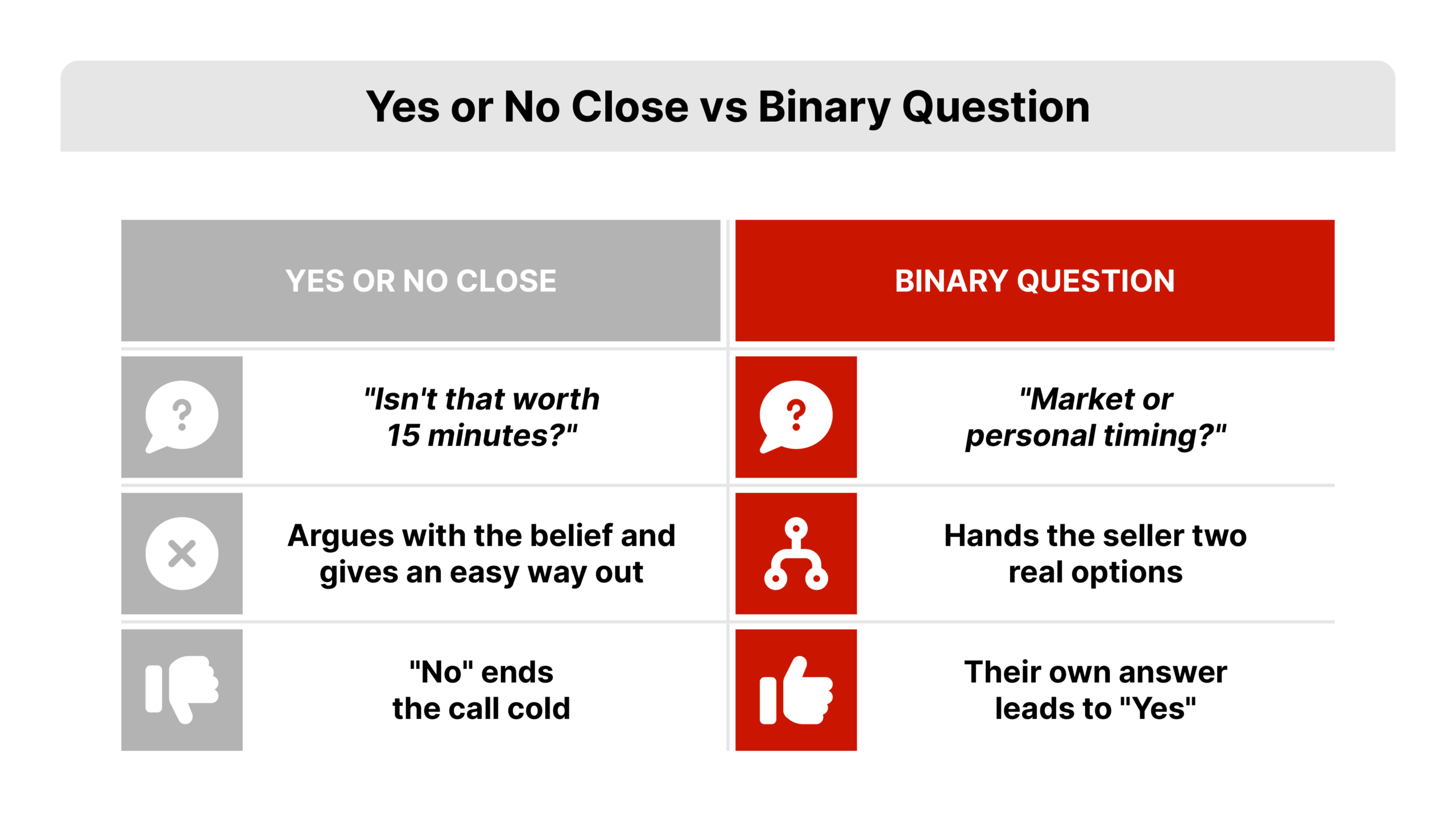
By trading yes-or-no questions for this-or-that questions. A yes-or-no close, like “Would you be open to sitting down for 15 minutes?” gives the seller an easy way out. Once they say no out loud, they’ve committed to that belief, and it’s hard to walk them back.
A binary question hands the seller two real options to choose between. It gives the seller room to clarify their belief on their own terms. Here’s the classic timing objection handled both ways:
Old way:
“Waiting is gambling with your equity. Rates aren’t coming down and neither is inventory. If I could get you your price in the next 30 days, isn’t that worth 15 minutes of your time?” That’s a yes-or-no question that argues with the seller’s belief, and a “no” ends the call cold.
Binary way:
“Got it. Are you waiting because of what’s going on in the market, or because of your personal timing right now?”
The seller has to think, not defend. If they say market, you can go one layer deeper: is it the interest rate or the price they’d get? Whatever answer they land on, you ask a follow-up question about that specific concern, and their own answer is what leads them to the appointment.
How Do You Handle Commission Objections in Real Estate?
By finding out whether the seller wants the lowest rate or real value for what they pay, not by listing every feature of your marketing plan. The instinct when someone asks “What’s your commission?” is to defend your worth immediately, with a long list of everything you do. That answer usually lands as noise.
Try the binary version instead:
“Are you asking because you want to find the lowest rate, or because you want to make sure that whatever you pay is actually worth it?”
If they say value, follow with: “What specific results would make you feel like the agent truly earned their fee?” Now you know exactly what to show them at the appointment. If they say lowest rate, ask what matters most to them besides the fee, like getting the home sold on time, and build from there.
How Do You Handle the “I Need to Talk to My Spouse” Objection?
By treating it as a real signal from the seller. Cornering someone into signing before their spouse weighs in rarely works, and pretending the objection is fake works even less.
Instead: “Makes total sense. Is that so you can make sure selling still makes sense, or just to make sure you two are on the same page with next steps?”
If it’s whether selling makes sense, ask what the two of them are most concerned about right now. If it’s next steps, ask what matters most to their spouse in the process. Either answer gives you something real to respond to, and a real reason to sit down together.
What Do You Say to Close the Appointment?
Once an objection starts to dissolve, ask for the appointment directly. Sellers rarely invite themselves over just because a conversation went well. Fenn’s line, used the same way across every objection type: “That’s exactly why it makes sense for us to sit down together, so I can show you (whatever’s relevant), would today or tomorrow work better?”
It works because it directly answers whatever the seller just told you, so it never feels like a scripted pitch. And since you got there with a binary question, “would today or tomorrow work better” is one more this-or-that question, never a yes-or-no ask that gives them a final exit.
How Do You Turn Objection Handling Into a Skill You Actually Own?
By practicing it out loud until it’s automatic, not by keeping a playbook open while you prospect and hoping it sticks. Reading a binary question for the first time while a seller is on the line is a different skill than delivering it from memory. Fenn recommends a standing weekly practice session, ideally role-playing with another agent, where you run through the three objection groups and their binary questions until they sound like your own words.
The volume matters as much as the skill. Fenn framed a rough example for his webinar audience: prospecting consistently, then lifting the appointment rate on those conversations from one in 30 to one in 10, a jump he called realistic once objection handling stops derailing the call. He offered it purely as an illustration of what changes when one part of the funnel improves.
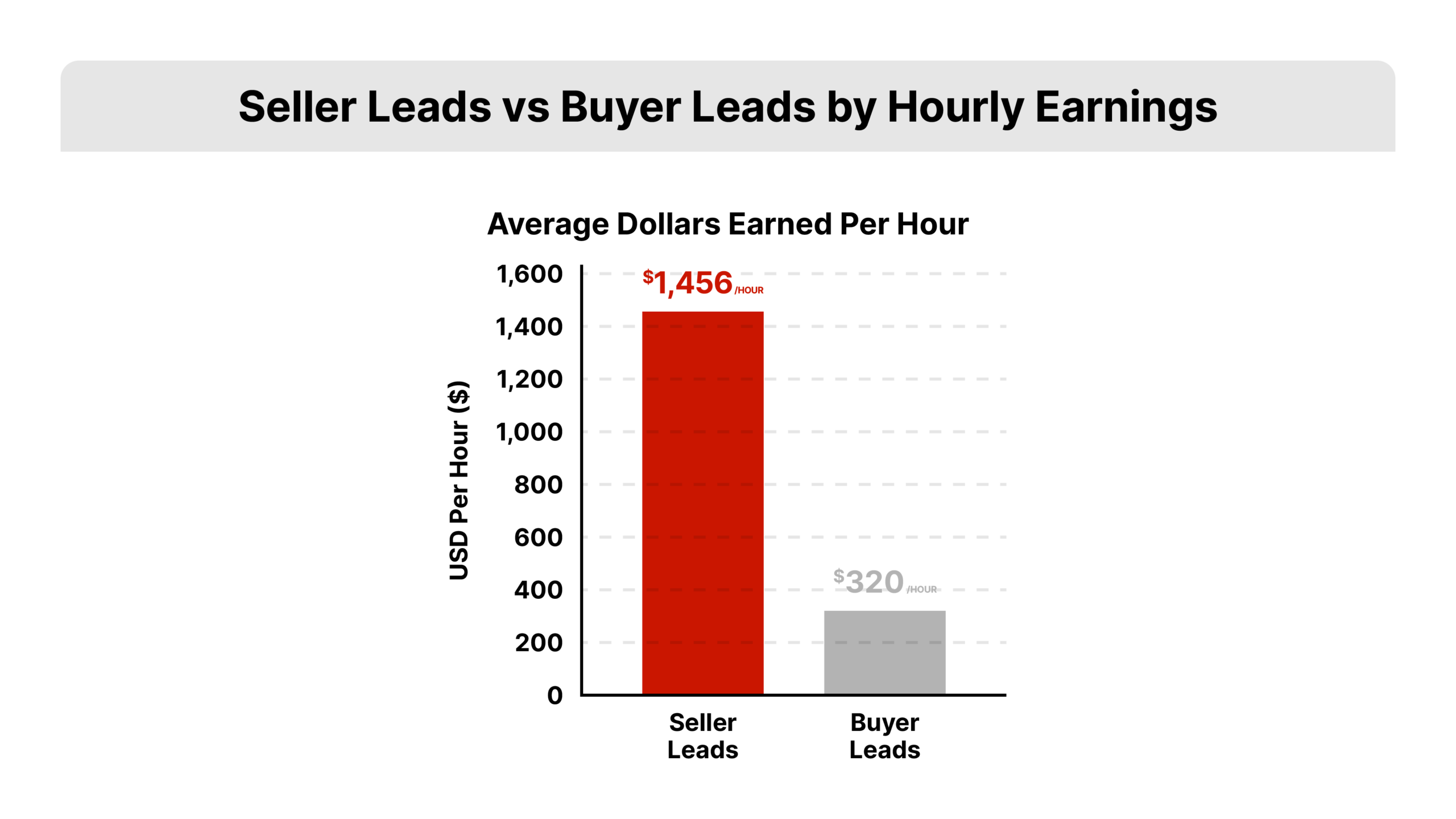
Two approved numbers explain why this particular skill is worth the practice. Internet leads convert at roughly 1% annually, according to Ylopo, which is why converting the seller conversations you’re already generating matters more than chasing additional leads. And according to Redfin independent agent analysis, agents earn approximately $1,456 an hour on seller leads versus $320 an hour on buyer leads, which is exactly why seller-side objections deserve this much attention.
Kent Brown, a senior trainer alongside Fenn at Listing Academy, is proof repetition compounds. He built $177,000 in GCI in approximately 53 days, 80% of it from REDX leads, on the back of 1,000 calls a day. On average, REDX agents overall take 3x more listings than the average agent, a gap built on exactly this kind of consistent practice.
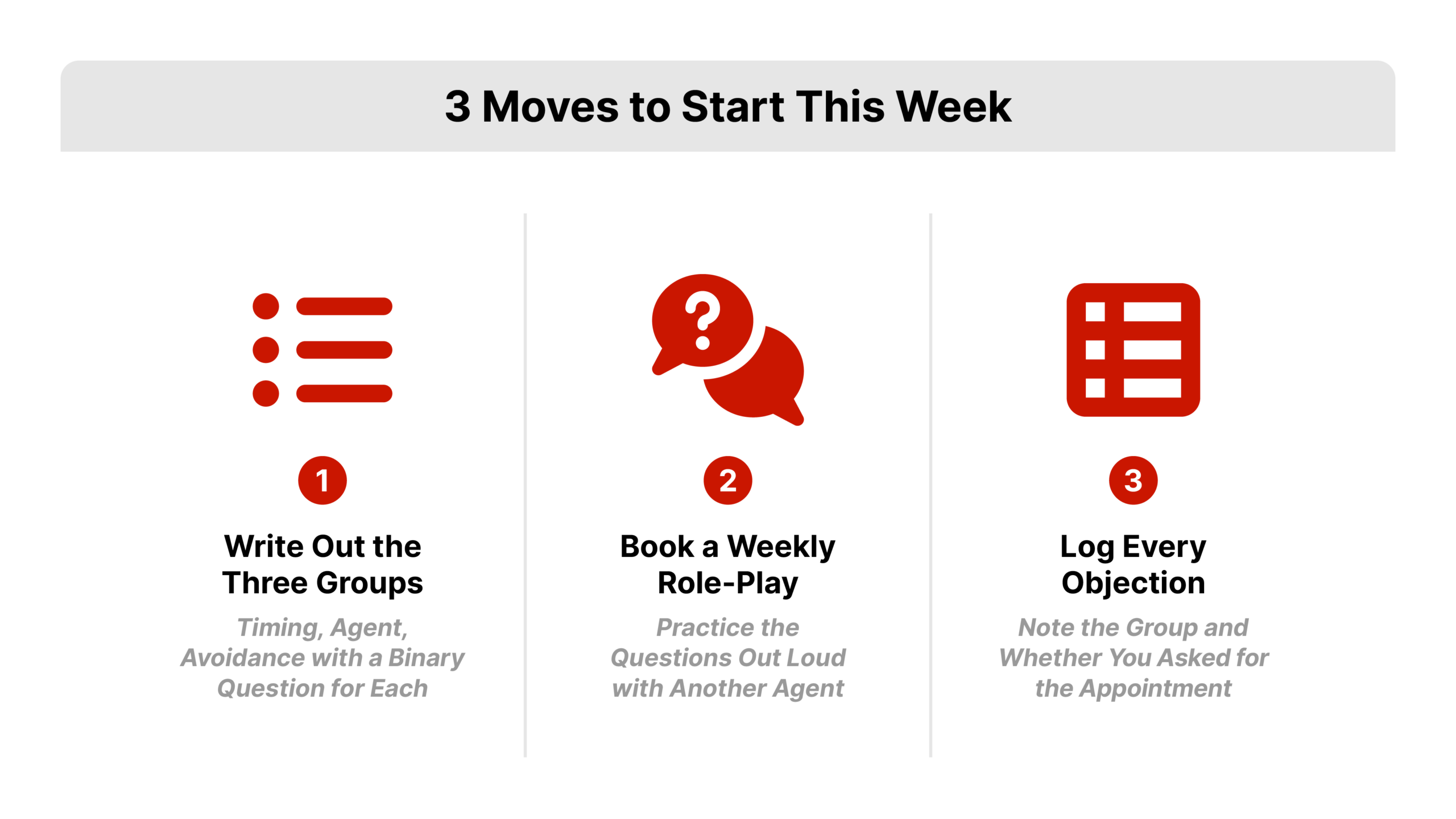
Three moves to start this week:
- Write out the three objection groups, Timing, Agent, Avoidance, with the binary question for each, and keep them somewhere you’ll actually see them before you dial.
- Book one recurring practice session a week to role-play those questions out loud with another agent until they stop sounding rehearsed.
- After every prospecting session, note which group each objection fell into and whether you actually asked for the appointment once it dissolved.
Key Takeaways
- Objection scripts that argue with a seller’s belief trigger psychological reactance (Brehm, 1966) and make them dig in. Questions that let the seller reach their own conclusion (Aronson, 1999) work instead.
- Every seller objection is Timing, Agent, or Avoidance. Identify the group first, and the response gets simple.
- Binary, this-or-that questions replace yes-or-no closes so a seller never gets an easy “no” that ends the call.
- The closing line “that’s exactly why it makes sense for us to sit down together” turns a dissolved objection into an asked-for appointment, every time.