Skip to content
 Ask three top producers for their circle prospecting strategy and you will get three different answers. That is a sign that circle prospecting has split into distinct methods, and the strategy that works for you depends on how much time, budget, and patience you actually have.
Over the summer, REDX hosted Ricky Carruth, Jeff Glover, and Tristan Ahumada for the Circle Prospecting Summer Series. All three sell real estate at a high level. All three use homeowner data to work a geographic area. And all three disagree about what the phone call is for.
This post breaks down all three circle prospecting strategies, the exact scripts, the numbers behind them, and how to pick the one that fits your business.
Quick Links:
- Does Circle Prospecting Still Work?
- What Is the Move-Up Invitation Circle Prospecting Strategy?
- What Is Hybrid Farming, and How Is It Different From Circle Prospecting?
- What Is the Attraction-First Circle Prospecting Strategy?
- Which Circle Prospecting Strategy Should You Choose?
- What Should Your First 30 Days of Circle Prospecting Look Like?
- Key Takeaways
Does Circle Prospecting Still Work?
Yes, but the circle prospecting strategy most agents were taught is the weakest of the three. The classic “I just sold a home in your neighborhood, would you consider selling?” call still produces listings, and every one of these coaches has built a business on geographic data. What has changed is that pickup rates have dropped, so the top producers have each rebuilt the process around a different core idea.
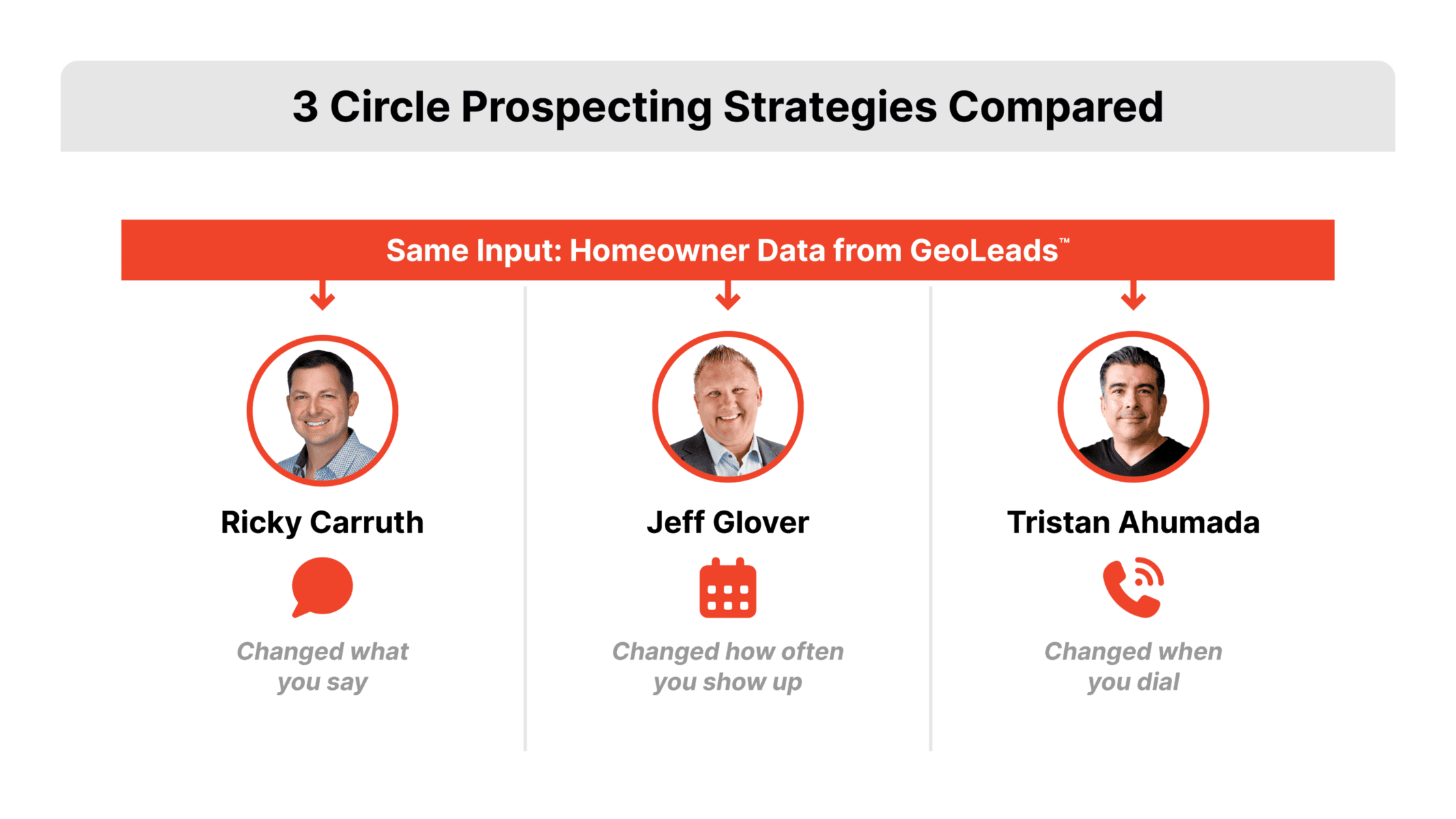
Each coach kept the same data source and changed one variable. Here is the split in one line each:
- Ricky Carruth changed what you say. He calls owners of smaller homes near a big listing and invites them to move up.
- Jeff Glover changed how often you show up. He works one neighborhood every single month instead of chasing scattered listings.
- Tristan Ahumada changed when you dial. He makes the call the last touch instead of the first.
All three circle prospecting strategies depend on repeat contact over time, which is consistent with the National Association of Realtors research showing most sellers hire an agent they already know or were referred to. Before you dial any list, remember that REDX recommends agents avoid dialing numbers on the Do Not Call list, regardless of which strategy you choose.
What Is the Move-Up Invitation Circle Prospecting Strategy?

Co-authored by the REDX Publishing Team and:
Ricky Carruth
Ricky sold over 1,000 homes as a single agent, was the #1 RE/MAX agent in Alabama, and has coached more than 100,000 agents.
Ricky Carruth’s circle prospecting strategy flips the usual call on its head. Instead of asking neighbors to sell, he pulls owners of cheaper homes near an expensive listing and invites them to upgrade into it.
Carruth sold more than 1,000 homes as a single agent and hit seven figures in GCI five years running in Alabama. His logic is that asking “would you consider selling?” makes you sound like every other agent, and it asks people to walk away from a house they probably love.
How to Set Up the Pull
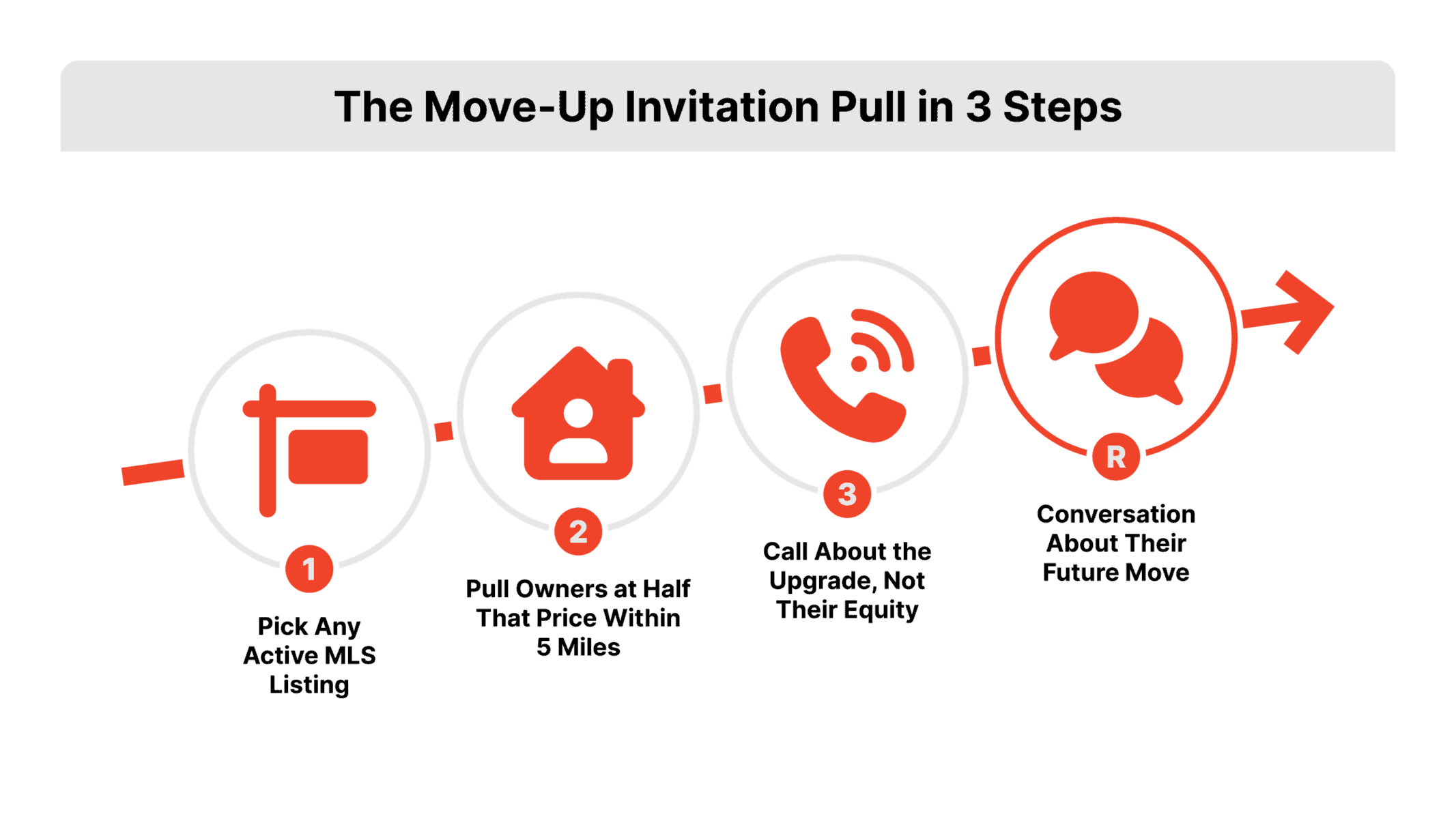
- Open the MLS in the morning and pick any active listing. It does not have to be yours.
- Pull owners of homes at roughly half that price or lower within a five mile radius. His example: a $20 million anchor listing means you pull $10 million owners nearby.
- Call them about the upgrade, not about their equity.
The Script
Carruth’s opener is short and specific to their property:
“Hey, I see you’re in this three-bedroom over here on Fairmont Street. Would you guys by chance be thinking about getting into a four-bedroom? Because I got a really nice one right around the corner I’d love to show you.”
When they say no, he does not push. He asks one question and then listens:
“Cool. Do you guys think you’ll ever move?”
That question is the whole method. In his words, “You don’t have to try to get them to do anything. What you have to do is get them to tell you what it is they want to do.” He also handles objections by agreeing with them rather than fighting them, on the theory that an objection is the prospect telling you how they want to be helped.
Where This Circle Prospecting Strategy Breaks From Convention
Carruth no longer cold calls at all. He shifted his own outreach to text, email, and direct mail, still pulling the data from REDX, and reports roughly 5% engagement on each channel for about 15% combined. He also refuses to do traditional follow-up. Everyone he speaks with goes into a weekly email that goes out the same day every week, forever.
However, Ricky is able to do that because he spent almost a decade cold calling and building his sphere of influence. For more on that strategy, check out our guide to building your sphere of influence featuring Ricky Carruth.
What Is Hybrid Farming, and How Is It Different From Circle Prospecting?

Co-authored by the REDX Publishing Team and:
Jeff Glover
Jeff leads a Michigan team selling 950 to 1,000 homes a year and created the hybrid farming system taught at Glover U.
Jeff Glover argues that a call-only circle prospecting strategy cannot make you the go-to agent in a neighborhood, because your listings are scattered across the map. His fix is hybrid farming: pick one neighborhood and contact it every month with something valuable, whether or not you have a listing there.
Glover’s team does 950 to 1,000 units a year in Detroit, and hybrid farming is now a top-five source of their listings. His definition, which he repeats until the room writes it down, is “reaching out to one particular neighborhood or community consistently once per month to add value to that group.”
How to Pick the Neighborhood
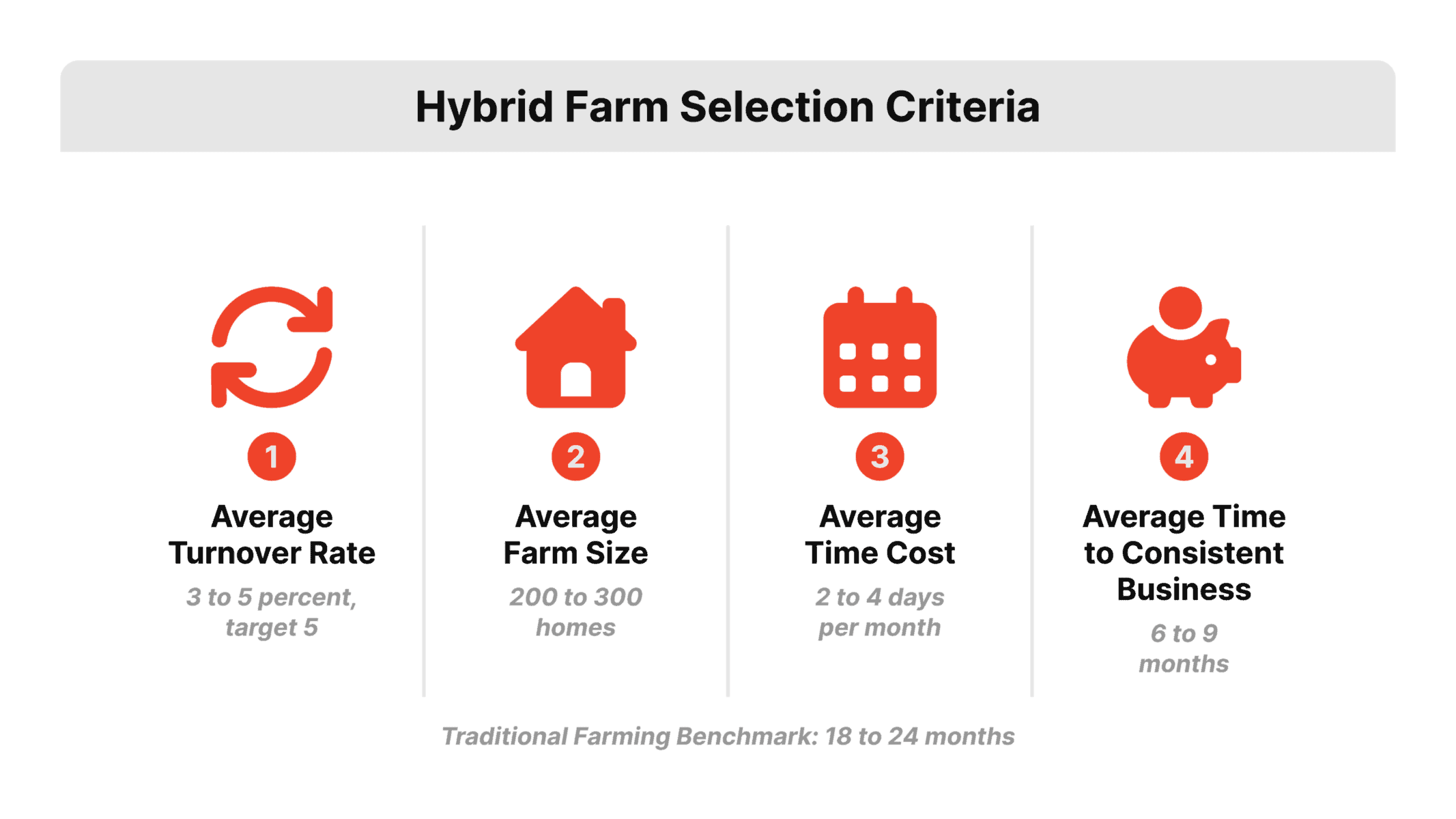
Glover uses one hard filter: annual turnover rate between 3% and 5%, and he wants you as close to 5% as possible. Divide the neighborhood’s annual sales by its total rooftops. A 100-home neighborhood with five sales a year is at 5%.
- Target farm size: 200 to 300 homes
- Turnover sweet spot: 5%, with 3% as the floor
- Time cost: two to four days per month
- Time to consistent business: six to nine months, versus 18 to 24 for traditional farming
REDX built a turnover rate filter directly into GeoLeads after these sessions, so you can screen neighborhoods on this criterion before you commit a year to one. If you want the broader playbook, our guide to real estate farming covers the fundamentals.
The Monthly Script
The first contact disarms before it asks for anything:
“Hi, my name is [name] with [brokerage], and I wanted to give you a quick update on your home’s value. Don’t worry, I’m not here to sell you anything. I’m just informing all of our neighbors that in the last 30 days, there have been three listings, two sales, and one just closed last week.”
Then the trigger question, which he deliberately asks twice: “Who do you know that’d like to move into our neighborhood? Can you think of a neighbor, a relative, a friend that may be interested in making a move right now?”
The step Glover calls the most critical is the capture, not the appointment:
“Would it be of value to you if I kept you on my list to receive equity updates on your home from time to time when a home is listed or sold in the neighborhood?”
Followed immediately by “Great. What’s the best number to reach you on? And your email address is?” If they will not give a phone number, take the email and move on.
What Fills the Other 11 Months
The monthly touch does not have to be a call. Glover’s agents rotate through community guides, a neighborhood Facebook group they own, sponsored food trucks, subdivision garage sales, paper shredding trucks, gift card giveaways from local businesses, and neighbors-only twilight open houses held the night before a listing goes live. One of his agents took 50% of the active listings in a 350-home farm inside 18 months on a budget under $2,500 for the year.
What Is the Attraction-First Circle Prospecting Strategy?

Co-authored by the REDX Publishing Team and:
Tristan Ahumada
Tristan built a team doing $100 million in annual volume and founded Lab Coat Agents, a community of more than 137,000 real estate professionals.
Tristan Ahumada’s position on circle prospecting strategy is that the phone should be the last touch, not the first. By the time you dial, the homeowner should already recognize your name from somewhere else.
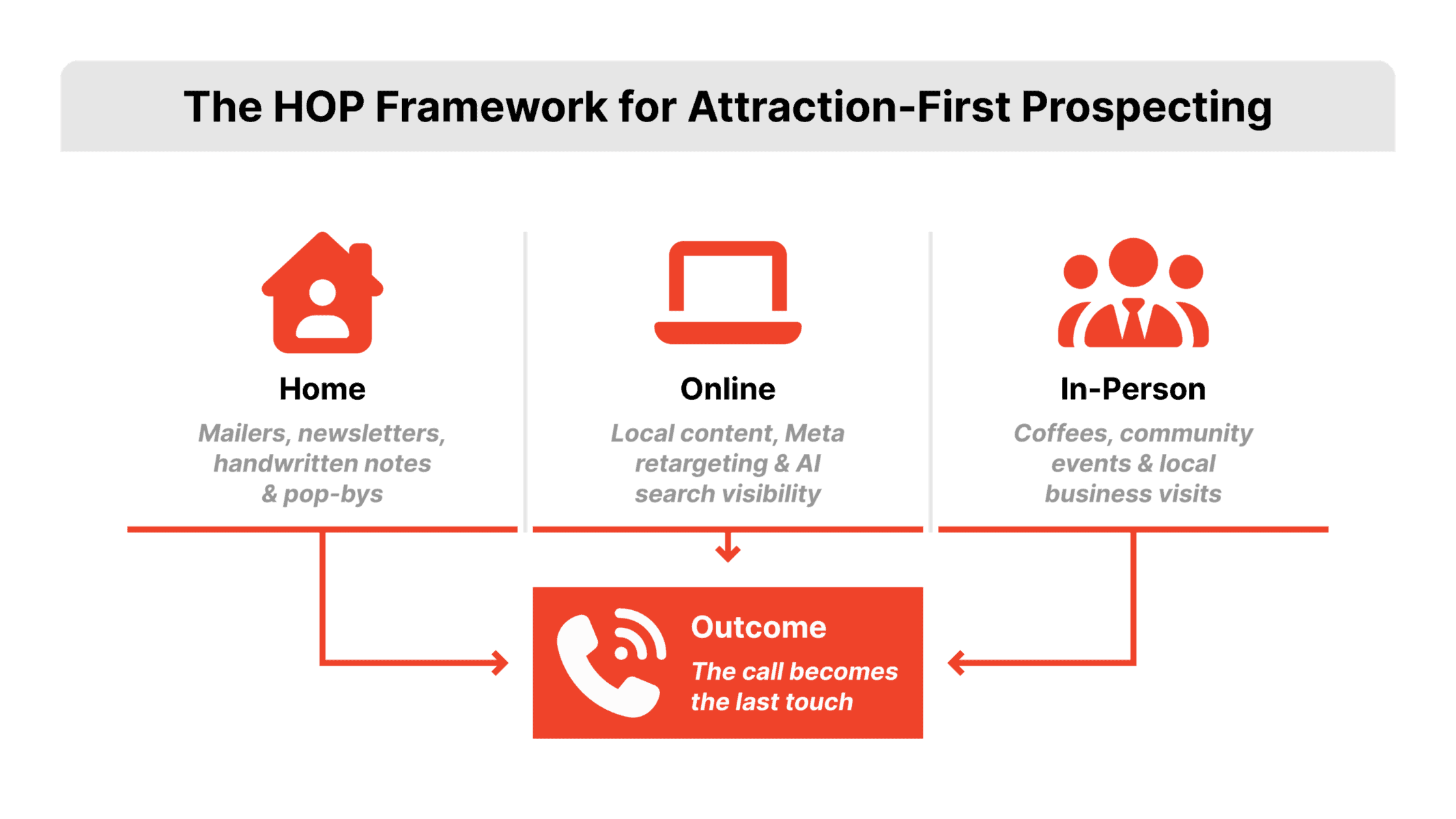
Ahumada built a team doing $100 million in annual volume and runs a real estate community with more than 137,000 members. His framework is HOP: Home, Online, In Person.
- Home: mailers, newsletters, homeowner guides, handwritten notes, and pop-bys. His cadence for core past clients is one pop-by and one homeowner guide per year plus two handwritten notes, not monthly contact.
- Online: localized blog and video content, Meta retargeting aimed at the farm, and structuring content so AI search tools can surface it. He reports that one in two of his blog posts now lands on page one and inside the AI overview.
- In Person: two or three coffees or lunches a week, community events, and local business visits.
Who This Circle Prospecting Strategy Says to Call
His most useful twist for anyone with call reluctance: point the dials at local businesses instead of homeowners. Contractors, lenders, restaurant owners, and service providers pick up the phone, and they are the ones sitting on referrals. Ahumada built a vendor directory he calls his Local Legends directory, hands it to homeowners as a value piece, and sends business to those vendors before ever asking for anything back. He sent his electrician three clients in four months before making an ask.
He is blunt about the sphere call most agents make. Asking “who do you know that wants to buy or sell?” is, in his words, tone-deaf. He had a two-hour lunch with a past client, asked for nothing, and got a $4.5 million listing referral two days later.
Which Circle Prospecting Strategy Should You Choose?
Pick your circle prospecting strategy based on your constraint, not your preference. Each of the three solves a different bottleneck.
| If your problem is… | Use this circle prospecting strategy | Why it fits |
|---|---|---|
| You need conversations this week | Move-up invitation (Carruth) | Works off any active listing, no setup, no budget |
| You want to own one neighborhood | Hybrid farming (Glover) | Frequency builds recognition; two to four days a month |
| Nobody picks up when you call | Attraction-first (Ahumada) | Warms people before the dial; call vendors instead |
| You have no marketing budget | Carruth or Glover’s call-only version | Both run on data and a phone alone |
| You are already visible locally | Attraction-first | Converts existing awareness into conversations |
One expectation to set regardless of which circle prospecting strategy you run: geographic leads are long-term database builders. According to REDX data, GeoLeads typically convert on a 90 to 120 day or longer window, compared to 30 to 60 days for expired listings. Sphere of influence contacts convert at 3% to 5%, which is why all three coaches obsess over capturing emails and phone numbers on every single touch.
What Should Your First 30 Days of Circle Prospecting Look Like?
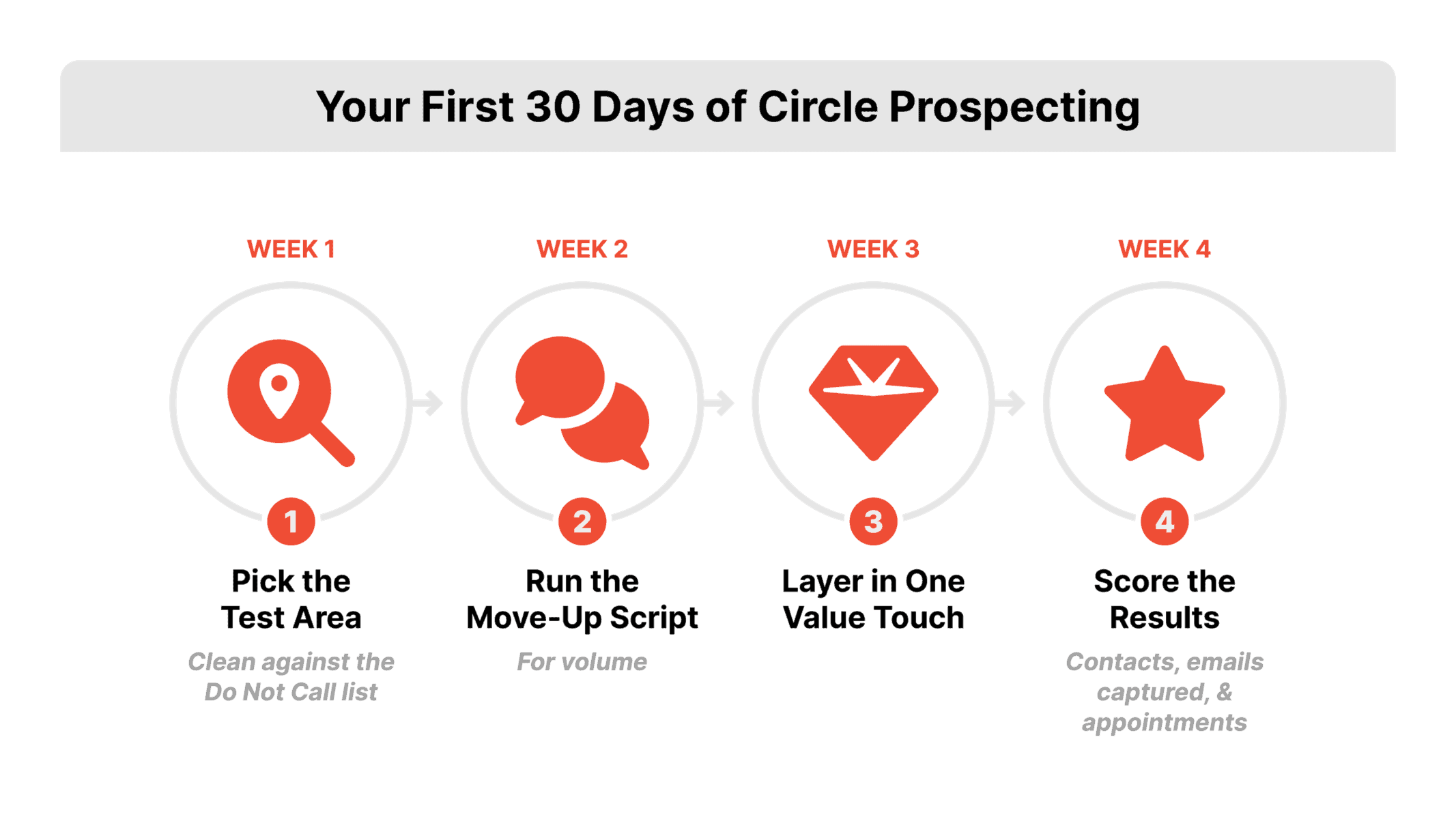
Run this 4-step sequence before you commit a full year to any one circle prospecting strategy.
- Week 1: Pick your test area. Screen for 3% to 5% turnover and land on 200 to 300 homes. Pull the data and clean it against the DNC list.
- Week 2: Run Carruth’s script for volume. Use an active listing as your anchor and make the move-up call. This tells you fast whether your area picks up the phone.
- Week 3: Layer in one value touch. Send a market update or drop a community guide. Measure how many contacts give you an email.
- Week 4: Score it. Count contacts made, emails captured, and appointments set. If contact rate is under 5%, shift your circle prospecting strategy toward the attraction-first approach. If it is healthy, commit to the 12-month hybrid farming calendar.
Track email capture as the primary metric for your circle prospecting strategy, not appointments. Every one of these coaches measures the database first, because a 200-home farm you can reach by email every month is worth more than a listing you happened to catch this quarter.
Key Takeaways
- There are three circle prospecting strategies now, not one. Carruth changed the script, Glover changed the frequency, Ahumada changed the timing of the call.
- The move-up invitation is the fastest circle prospecting strategy to start. It beats “would you consider selling?” because you call owners of cheaper homes near a big listing and invite them to upgrade.
- Hybrid farming needs 3% to 5% turnover and 200 to 300 homes. Expect six to nine months to consistent business at two to four days of work per month.
- Capture the email on every touch. GeoLeads convert on a 90 to 120 day or longer window, so whichever circle prospecting strategy you pick, the database is the asset, not the appointment.