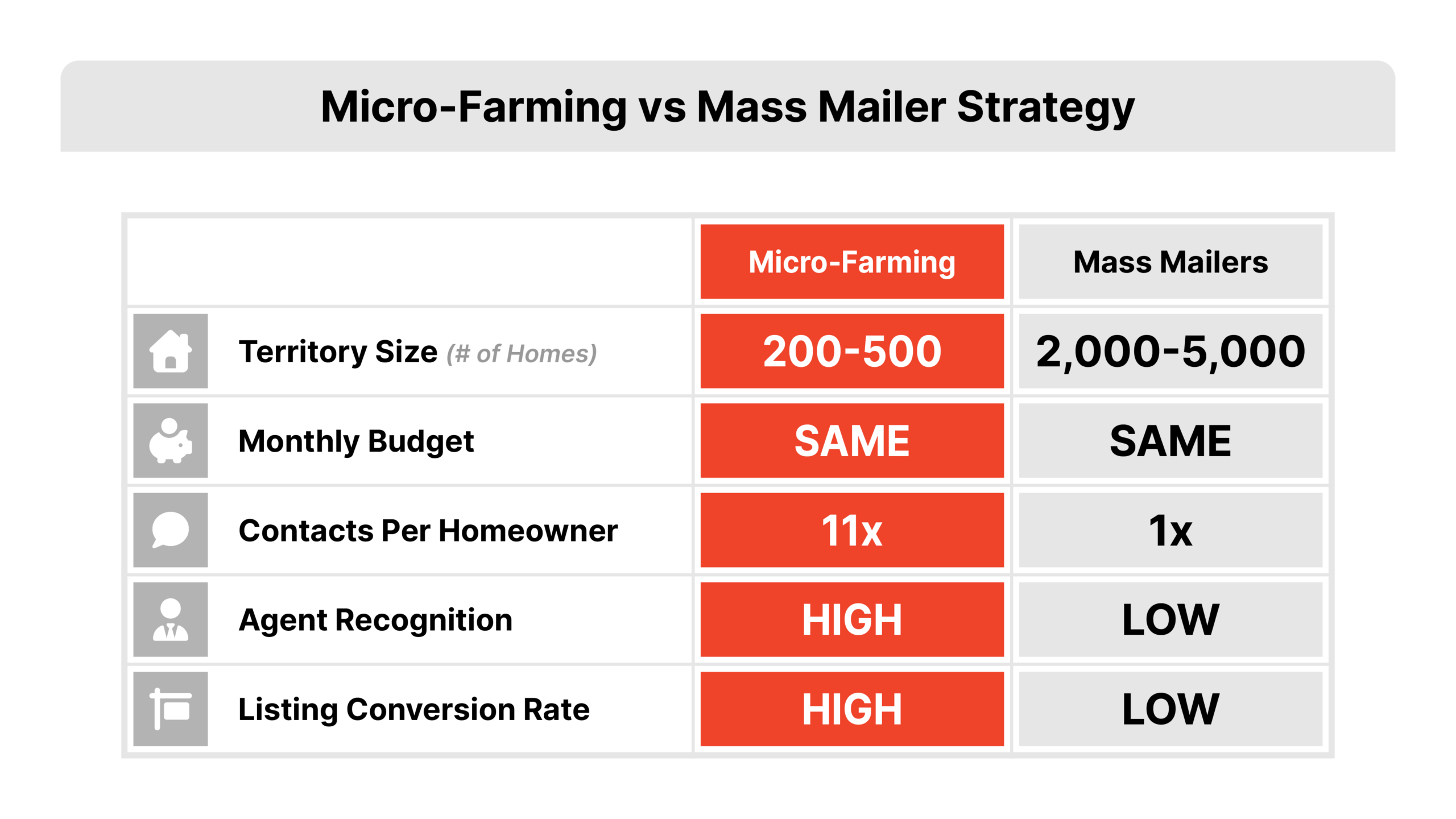
Micro-farming changes the math entirely. By targeting a highly specific geographic territory of 200 to 500 homes, agents can achieve contact frequency, hyper-local knowledge, and genuine community presence that no mass mailer program can replicate. The result is not just name recognition. It is the kind of trusted-neighbor reputation that produces listings from sellers who have not even thought about selling yet.
This post explains what micro-farming is, how to select the right territory, how many homes should be in it, and what it takes to become the go-to listing agent for a specific neighborhood in 2026.
Key Takeaways
- A micro-farm of 200 to 500 homes allows an agent to be genuinely known in that area. Mass mailers sent to 5,000 homes produce name recognition. Micro-farming a tight territory produces listing dominance.
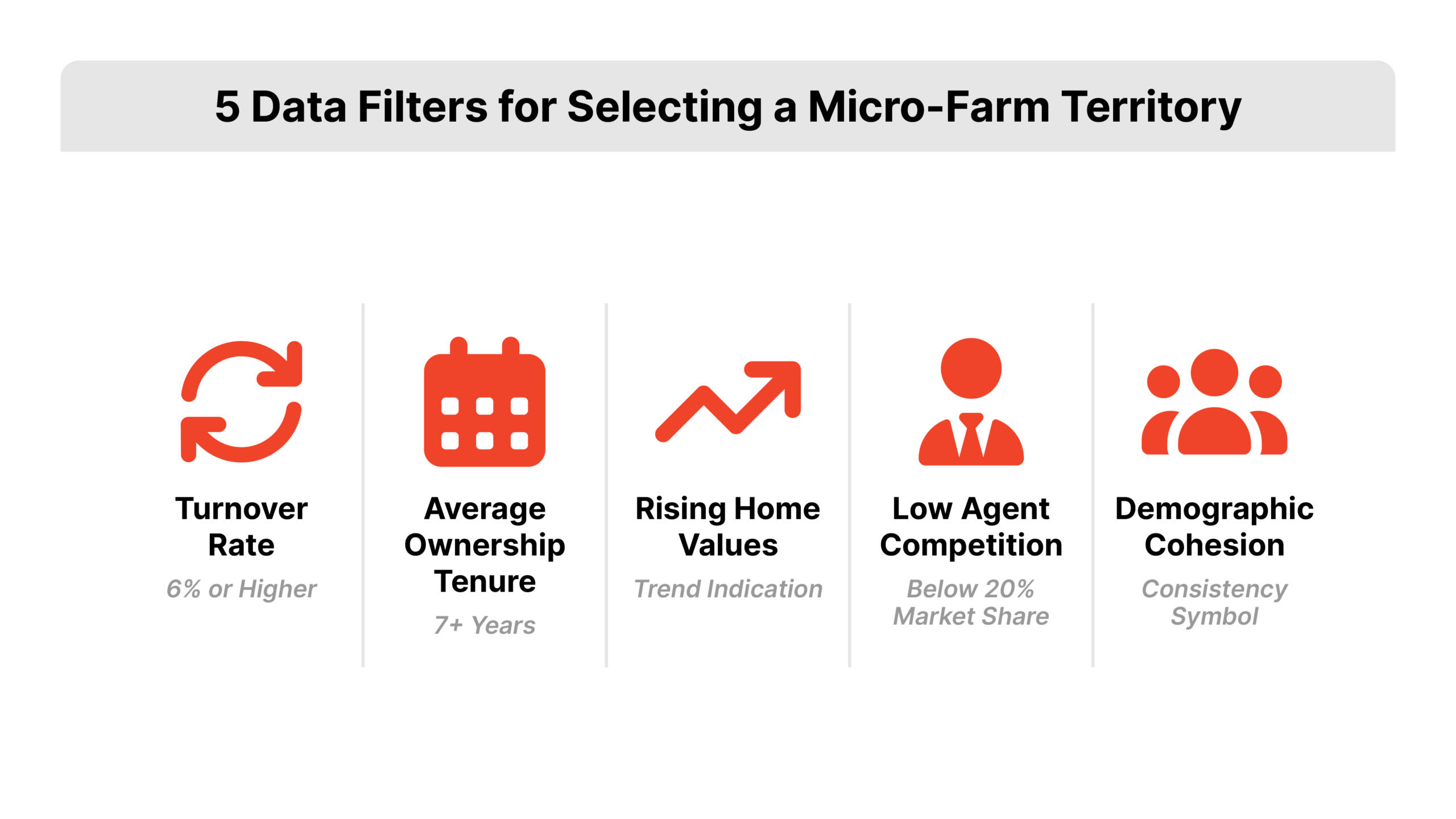
- The best micro-farm territories have a turnover rate of 6% or higher annually and average ownership tenure of 7 years or more, meaning sellers are both active and overdue.
- Micro-farming works because frequency and specificity beat volume. A homeowner who receives five personalized, hyper-local contacts from one agent over 90 days is far more likely to call that agent than one who received a generic postcard once.
- Geographic data, not guesswork, should determine which neighborhood you farm. Ownership tenure, turnover history, and demographic patterns are all identifiable before you spend your first dollar.
Quick Links:
- What Is Micro-Farming in Real Estate and How Does It Work?
- How Many Homes Should Be in a Micro-Farm Territory?
- How Do You Identify Which Neighborhoods to Farm Based on Ownership Length and Turnover Rate?
- What Does a Winning Micro-Farm Contact Sequence Look Like?
- How to Launch Your Micro-Farm and Measure Whether It Is Working
What Is Micro-Farming in Real Estate and How Does It Work?
Micro-farming is a geographic prospecting strategy in which an agent focuses all their farming activity on a small, well-defined territory, typically 200 to 500 homes in a single neighborhood, subdivision, or zip code segment. The goal is to become so visible and so knowledgeable about that specific area that homeowners call you before they call anyone else.
It works for a straightforward reason: homeowners choose agents they recognize and trust. In a micro-farm, you have enough budget concentration to contact every homeowner in your territory frequently, by mail, by phone, and sometimes in person. That repetition builds the kind of familiarity that mass mailers cannot buy at scale.
The contrast with mass mailer campaigns is significant. A 5,000-home mailer campaign at 88 cents per postcard costs $4,400 per month for a single touch. A micro-farm of 400 homes at the same cost per piece allows you to contact every homeowner eleven times per month for the same budget. Frequency beats volume for trust-building every time.
How Many Homes Should Be in a Micro-Farm Territory?
The right territory size depends on your budget and your bandwidth for personalized outreach. The general rule is simple: your farm should be small enough that you can realistically contact every homeowner in it at least once per month through some combination of mail, calls, and in-person activity.
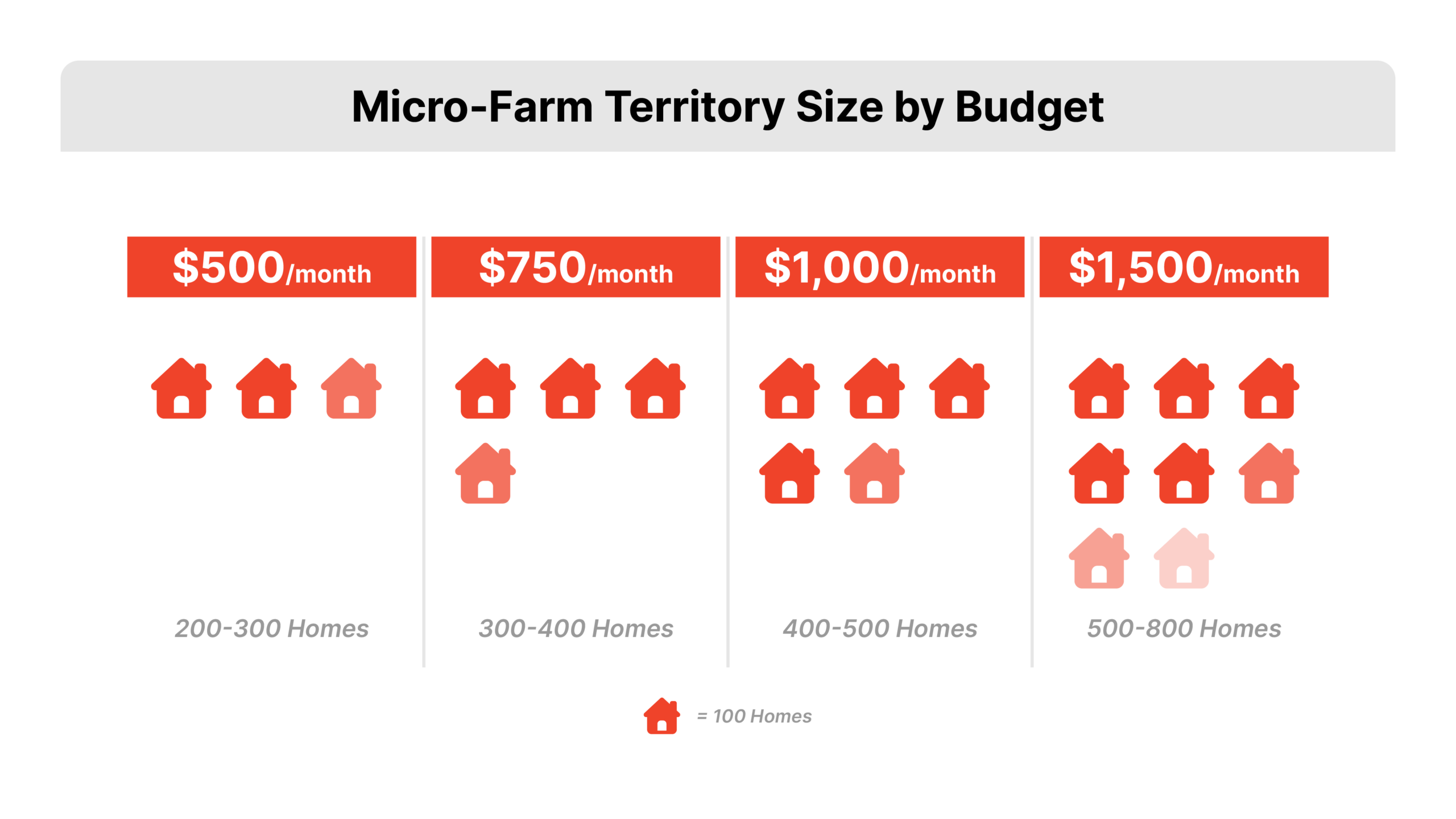
For most agents working with a budget of $500 to $1,000 per month on farming, 200 to 400 homes is the right range. That budget, applied to a territory of 300 homes, allows you to send a personalized postcard, make a follow-up call, and drop off a market report once per quarter, all for the same monthly cost as a single mass mailer campaign that reaches 1,000 homes once.
Agents with a higher budget or a team support model can expand to 500 to 800 homes, but only if the added volume does not come at the expense of personalization. The moment your farm becomes too large to know each homeowner individually, you have lost the advantage that makes micro-farming work.
How Do You Identify Which Neighborhoods to Farm Based on Ownership Length and Turnover Rate?
Selecting the wrong territory is the most common reason micro-farming fails. An agent who picks a neighborhood based on where they live, where they grew up, or where they personally want to work, rather than on data, often finds a low-turnover area that produces few listings no matter how consistent the outreach.
The two data points that matter most when selecting a micro-farm territory are turnover rate and average ownership tenure. Target neighborhoods with a turnover rate of 6% or higher annually. That means in a 400-home territory, at least 24 homes sell each year, enough to sustain a consistent listing business from that area alone.
Average ownership tenure is the complement. Neighborhoods where homeowners have lived for 7 years or more are ideal because those homeowners are statistically due to sell. The national average ownership tenure is approximately 8 years, meaning any neighborhood with tenure above that is sitting on pent-up seller inventory.
Three additional filters that sharpen territory selection:
- Rising home values: Neighborhoods with consistent year-over-year appreciation motivate long-term owners to cash out. Appreciation data also gives you a compelling reason to call: “Your neighbors just got $X more than expected for their home.”
- Low agent competition: Use your MLS to identify neighborhoods where no single agent holds more than 20% market share. High competition in a territory means an incumbent is already entrenched. Low competition means the door is open.
- Demographic cohesion: Neighborhoods with similar household profiles, age, family stage, or income level, respond to messaging more consistently. A neighborhood of empty nesters is one conversation. A neighborhood of first-time buyers who bought five years ago is another.
REDX GeoLeads surfaces this kind of ownership-tenure and geographic data directly within your prospecting workflow, so you can identify high-potential micro-farm territories without manually cross-referencing multiple data sources.
What Does a Winning Micro-Farm Contact Sequence Look Like?
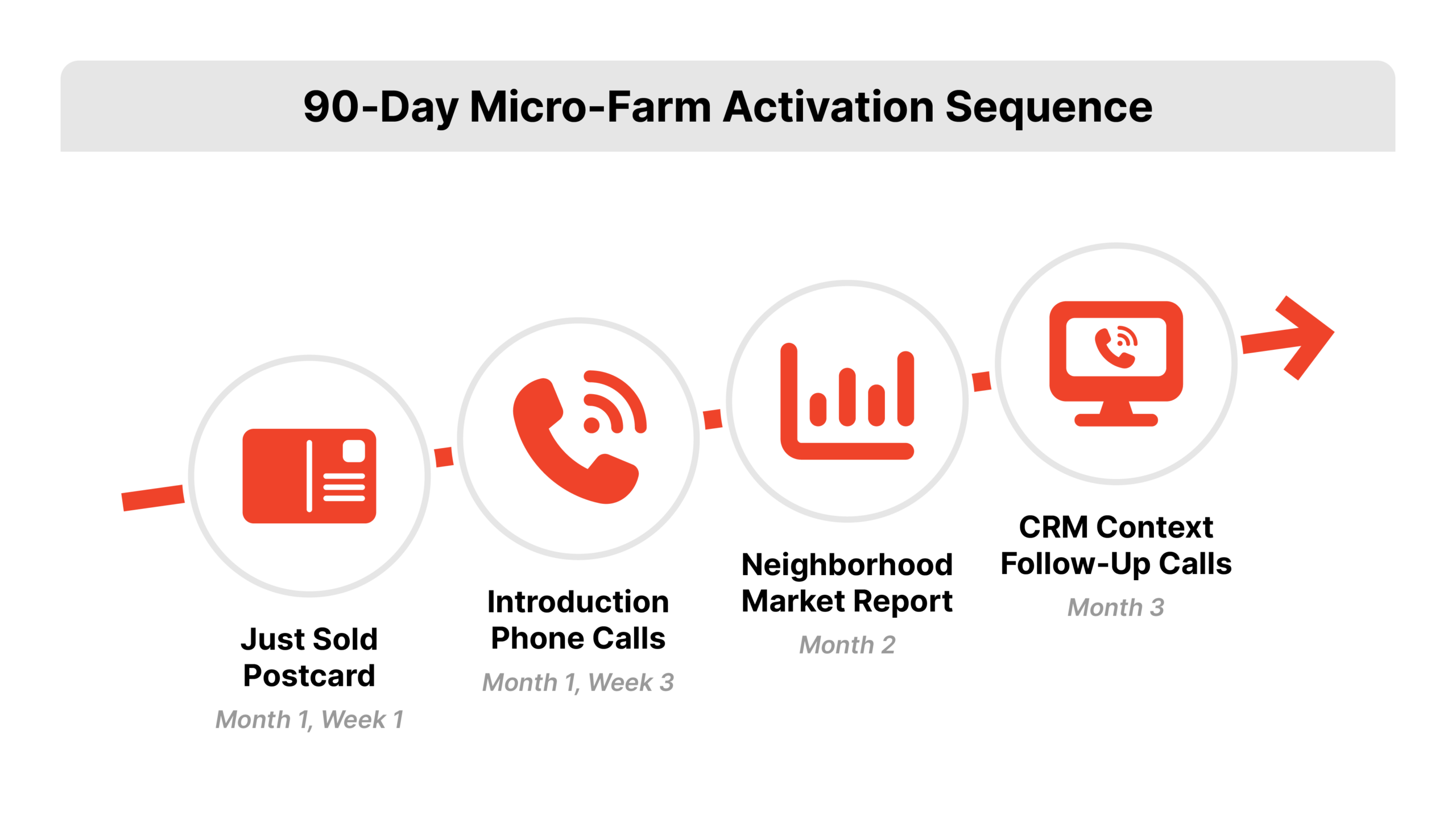
The contact sequence that builds agent dominance in a micro-farm territory relies on consistency and relevance, not volume. Here is a 90-day activation sequence that works for a new micro-farm:
- Month 1, Week 1: Send a “just listed” or “just sold” postcard for a recent comparable sale near the territory. No pitch. Just local market data with your name and contact information.
- Month 1, Week 3: Follow-up phone calls to homeowners using GeoLeads contact data. Introduce yourself, mention the recent sale nearby, and ask if they have thought about what their home might be worth in the current market.
- Month 2: Drop a neighborhood market report. One page. Average list price, days on market, and sold-to-list ratio for the last 60 days in their specific neighborhood. This is the kind of specific, useful content that generic mailer agents never send.
- Month 3: Second round of calls referencing anything from your first conversation. If you did not speak to them last month, reference a recent sale or market shift as the reason for calling. Keep your CRM notes current so every call feels like a continuation, not a cold start.
By the end of the first 90 days, you will have contacted most homeowners in your territory two to three times. In a territory of 300 homes, those contacts cost a fraction of what a single mass mailer campaign to 3,000 homes costs, and they produce a name-recognition rate that no mailer can match.
How to Launch Your Micro-Farm and Measure Whether It Is Working
Micro-farming is a long-term play. The agents who abandon it after 60 days are the same ones who never gave mass mailers a real chance either. The payoff window for micro-farming is typically 90 to 120 days before the first listing opportunity appears, and 6 to 12 months before the territory produces consistent monthly listings.
Three metrics worth tracking from day one:
- Contact rate: What percentage of homeowners in your territory have you spoken to at least once? Target 40% in the first 90 days.
- Recall rate: When you call someone for the second time, do they remember you? If fewer than 30% of second contacts recognize your name, your first-touch messaging is not distinctive enough.
- Listing conversion: Track every listing that comes from within your territory. Your goal in year one is to take at least 15% of all listings in your farm. In year two, 25% is achievable with consistent outreach.
Micro-farming is not a shortcut. It is the opposite of a shortcut. It is a commitment to a small geography, delivered consistently, until you own it. The agents who do this well do not just take listings from their farm. They create a compounding referral engine where every listing leads to a neighbor conversation, which leads to the next listing.