In real estate, your business is only as strong as your lead pipeline. Whether you’re a new agent looking to build your first client base or an experienced professional seeking to scale your business, mastering lead generation is essential for sustainable success.
This comprehensive guide will teach you how to generate real estate leads with a step by step break down of practical steps you can implement today to start growing your business.
Quick Links
- What Is Real Estate Lead Generation and Why It Matters
- Understanding Different Types of Real Estate Leads
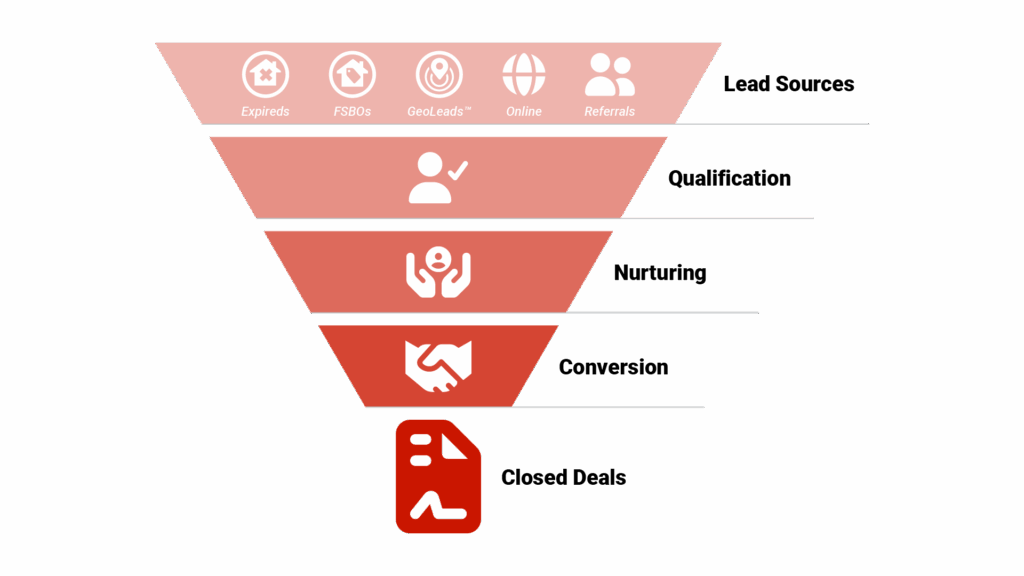
- Most Effective Real Estate Lead Sources
- Proven Offline Lead Generation Strategies
- Scripts and Follow-Up Tactics for Lead Generation
- Integrating Traditional and Digital Approaches
- Lead Management and CRM Systems
- Buying vs. Generating Your Own Leads
- 5 Quick Wins to Implement Today
- Frequently Asked Questions About Real Estate Lead Generation
- How to Generate Real Estate Leads (The Easy Way)
What Is Real Estate Lead Generation and Why It Matters
Real estate lead generation is the systematic process of attracting potential clients who are interested in buying, selling, or renting property. These prospects, or “leads,” become the foundation of your business pipeline and future commission income.
The Impact on Business Growth
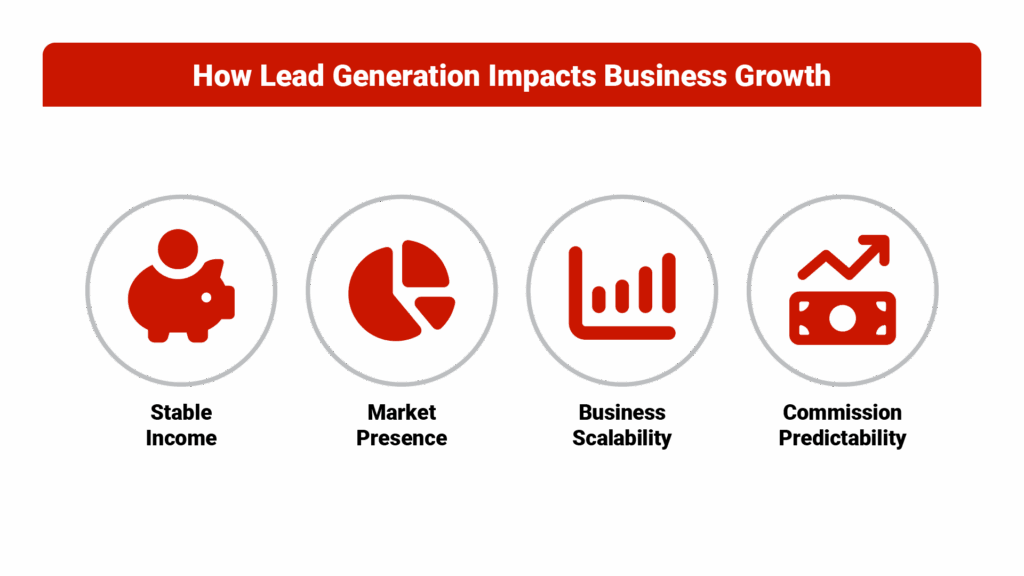
Effective lead generation directly impacts your:
- Income stability – Creating a consistent flow of opportunities
- Market presence – Establishing your reputation in specific neighborhoods
- Business scalability – Providing the foundation to grow your team
- Commission predictability – Reducing the feast-or-famine cycle
Generating leads and building a listing pipeline is a key point for most agents to build their business with REDX agents getting 3x more listings than the average real estate agent.
Different Types of Real Estate Leads
Not all leads are created equal. You can get real estate leads from thousands of different sources. To find the best leads for your business, separate them by their motivation, the effort you need to take to get them, and by the type of lead that takes the most time for you to convert. Here’s how each of those lead types can be separated.
Cold, Warm, and Hot Leads
- Cold leads: Prospects with no prior relationship who may have interest but aren’t actively looking (Example: For Rent By Owner leads or Investors)
- Warm leads: Prospects showing some interest in real estate services (Example: Website visitors who download your guide)
- Hot leads: Prospects actively seeking to buy or sell soon (Example: FSBOs, Expireds)
Every agent should try and balance their lead generation with equal parts cold, warm, and hot leads. But if you don’t have any hot leads today, focus on your hot and warm leads.
If you don’t have any cold, warm, or hot leads… check out our guide on the top 20 free and paid real estate lead generation strategies.
Inbound vs. Outbound Leads
- Inbound leads: Prospects who come to you through your marketing efforts (website inquiries, social media engagement)
- Outbound leads: Prospects you proactively contact (cold calling, door knocking, direct mail)
Most agents make the mistake of focusing too much on their inbound lead sources and find their real estate listing pipeline empty in slow seasons.
Make sure to balance your listing pipeline with BOTH inbound and outbound leads.
Buyer vs. Seller Leads
- Buyer Leads: Typically attained through online sources, buyer leads are leads actively in the market to buy a real estate property.
- Seller leads: Typically attained through seller lead lists, seller leads are usually outbound leads, you proactively contact. Examples include Expireds, FSBOs, and Pre-Foreclosures who are motivated to sell a home.
Buyer leads generally cost more to acquire, take longer to close, and bring in less money per hour for real estate agents. That’s why we highly recommend seller leads like Expireds and FSBO leads.
Most Effective Real Estate Lead Sources
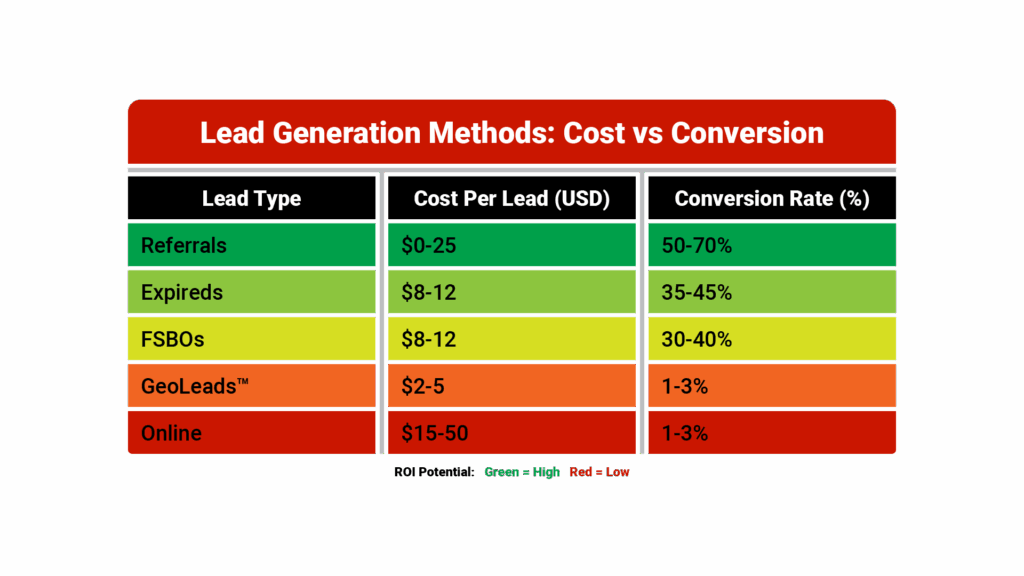
The most successful agents diversify their lead generation across multiple channels. Here’s how the most common sources compare:
High-Intent Seller Leads
- FSBO (For Sale By Owner): Homeowners actively trying to sell without an agent
- List rate: Approximately 38%
- Best approach: Educational marketing on the complexities of selling
- Expired Listings: Properties that didn’t sell during their listing period
- List rate: Approximately 43%
- Best approach: Problem-solving consultation on why the home didn’t sell
- Pre-Foreclosures: Homeowners facing financial distress
- List rate: Approximately 15%
- Best approach: Compassionate outreach offering solutions
Geographic and Relationship-Based Leads
- GeoLeads (Circle Prospecting): Targeting specific neighborhoods
- Conversion rate: 1-3% depending on approach
- Best approach: Neighborhood market updates and community involvement
- Referrals: Leads from past clients and your sphere of influence
- Value: $10,000 Lifetime value
- Best approach: Consistent value-added communication and appreciation
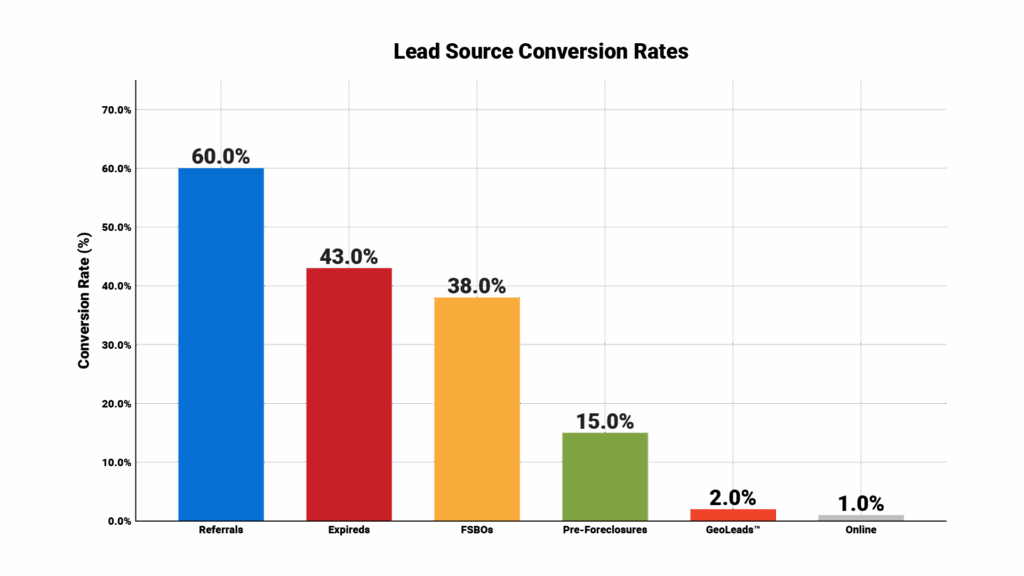
If the conversion rate of referrals seems high, its because it is. But its true. Volta Strategies claims referral rates can be as high as 60% specifically when working with business partners. This number represents people that have heard of you and reached out.
You have a very high likelyhood of converting these leads.
But for the most accurate information on how to generate referral traffic, check out our guide to generating referral leads, or use this Wall Street Prep referral calculator.
Proven Offline Lead Generation Strategies
Traditional methods remain highly effective, especially when systematized.
Door Knocking
- Select target neighborhoods based on turnover rates and price points
- Prepare value-first materials (market reports, recent sales)
- Create a consistent schedule (2-3 times weekly)
- Track all interactions in your CRM
- Follow up with those who showed interest
Networking and Community Involvement
- Join local business organizations (Chamber of Commerce, BNI)
- Volunteer with community organizations
- Host or sponsor community events
- Attend local government meetings
- Participate in school functions if targeting family neighborhoods
Direct Mail Campaigns
- Geographic farming: Consistent mailings to specific neighborhoods
- Just Listed/Just Sold: Announcements highlighting your success
- Market updates: Quarterly reports on neighborhood statistics
- Special occasion cards: Birthday, home purchase anniversary, holidays
Pro tip: Consistency trumps volume. A smaller, well-maintained list with regular contact outperforms sporadic mass mailings. Check out full guide to direct mail marketing to learn more.
Scripts and Follow-Up Tactics for Lead Generation
Scripts are an important part of any lead generation strategy. Knowing what to say, and how to say it is part of what makes each lead valuable in its own right.For the three best lead converssion types, here are the best questions to reveal their challenges.
Don’t rely too heavily on scripts though, they can make you sound robotic.
FSBO Scripts
Focus on questions that reveal their challenges:
- “What methods are you using to market your home?”
- “How are you handling showings with your work schedule?”
- “What’s your plan for negotiating with buyers?”
Expired Listing Scripts
Address their frustration constructively:
- “What do you think prevented your home from selling?”
- “If you were to list again, what would you want done differently?”
- “Have you considered [specific marketing strategy] for your home?”
Follow-Up Sequences
The fortune is in the follow-up. Create a structured approach:
- Initial contact: Introduction and value proposition
- 48-hour follow-up: Additional information based on their response
- Weekly check-ins: Market updates or relevant information
- Monthly value: Neighborhood reports or broader market insights
- Quarterly reconnection: Check on their situation and needs
Integrating Traditional and Digital Approaches
The most successful agents create synergy between offline and online methods.
Cross-Channel Strategy Example
- Door knock a neighborhood with market updates
- Collect email addresses for your newsletter
- Add contacts to social media targeted ad campaigns
- Mail physical postcards with QR codes to online resources
- Follow up with calls to those who engage with digital content
Lead Management and CRM Systems
Your system is as important as your sources.
Essential CRM Features for Real Estate
- Contact information storage and organization
- Lead source tracking and ROI calculation
- Automated follow-up sequences
- Task management and reminders
- Mobile accessibility for on-the-go updates
Check out REDX CRM integrations to know the best CRMs to integrate with your lead generation efforts.
Using Automation to Boost Conversion
- Power dialers: Make 3x more calls in the same time
- Email sequences: Nurture leads with valuable content
- Text messaging: Higher open rates than email (98% vs. 20%)
- AI assistants: Initial qualification and appointment setting
Buying vs. Generating Your Own Leads
Consider these factors when deciding your approach:
Purchased Leads
Pros:
- Immediate volume
- Less time investment upfront
- Can jumpstart a new business
Cons:
- Higher cost per acquisition
- Lower conversion rates (typically 1-3%)
- More competition for the same leads
Self-Generated Leads
Pros:
- Higher conversion rates
- Lower cost per acquisition long-term
- Builds sustainable business assets
Cons:
- Takes time to build momentum
- Requires consistent effort
- May need multiple channels to achieve volume
5 Quick Wins to Implement Today
- Set up Google Business Profile and request 5 reviews from past clients
- Create a simple follow-up system for existing leads
- Schedule 2 hours of dedicated prospecting time daily
- Join 3 local Facebook groups where your target clients gather
- Call 5 people from your sphere of influence to reconnect
Frequently Asked Questions About Real Estate Lead Generation
How many leads should I generate monthly?
For a full-time agent aiming for 24 transactions yearly, generate 20-30 new leads monthly with a 5-10% conversion rate.
How quickly should I follow up with new leads?
Ideally within 5 minutes. Response rates drop by 80% after the first hour.
What’s the best time to call prospects?
Early morning (7:30-8:30 AM), lunch hour (12:00-1:00 PM), and early evening (5:00-6:30 PM) typically yield the highest contact rates.
How do I measure lead generation ROI?
Track: Cost per lead, cost per appointment, cost per client, and lifetime value of clients from each source.
How to Generate Real Estate Leads (The Easy Way)
Successful real estate lead generation is about building systematic processes across multiple channels. Start with the strategies that align with your strengths and gradually expand your approach.
Remember that consistency trumps perfection. A simple system you follow daily will outperform complex strategies implemented sporadically.
By diversifying your lead sources, creating structured follow-up systems, and continuously measuring results, you’ll build a sustainable business that thrives regardless of market conditions.